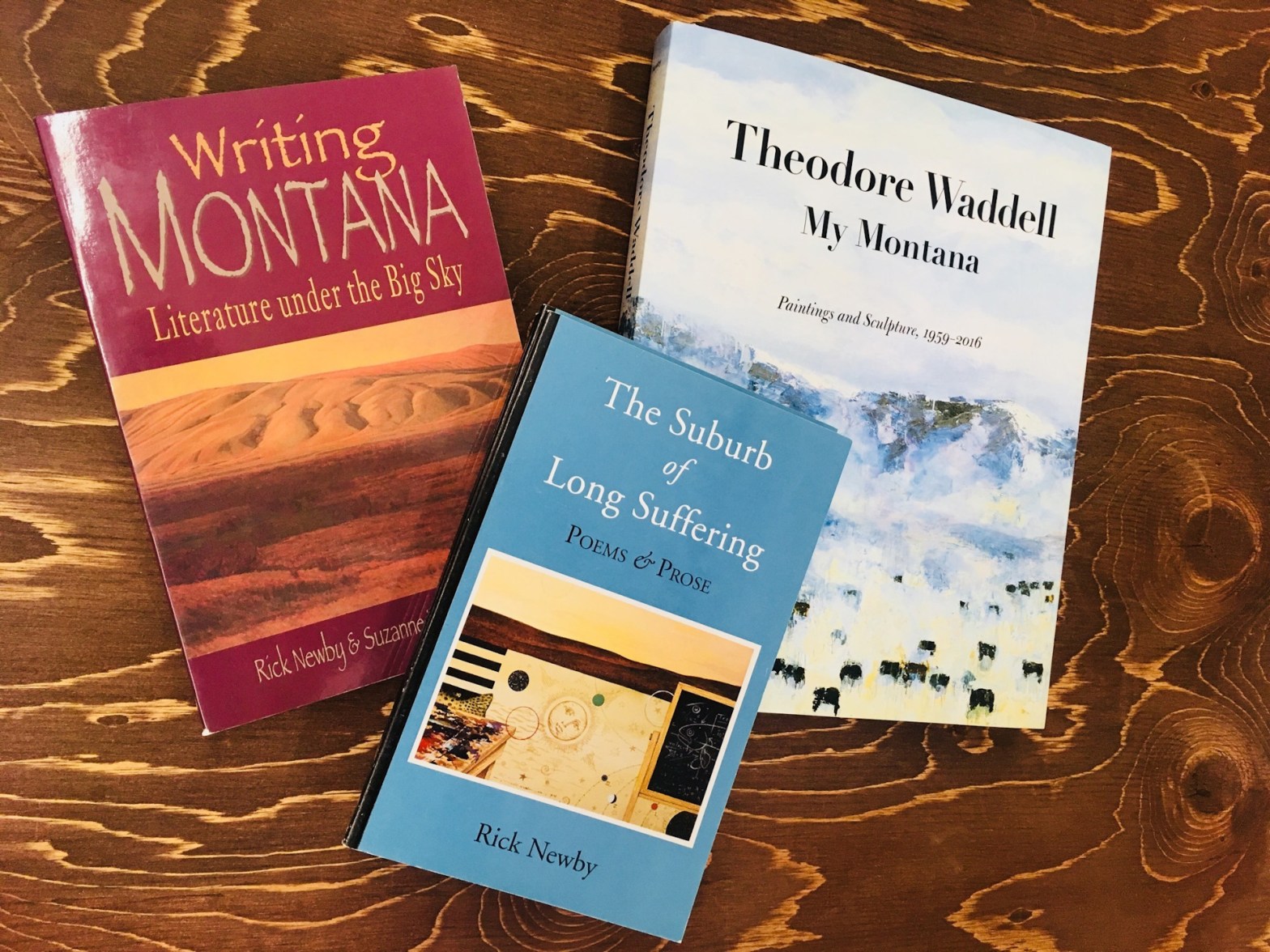
A Regionalism That Travels: Writings on (Mostly) Montana Arts
(Helena, MT: Drumlummon Institute in association with Bar R Books, 2024)
By Rick Newby. Foreword by Melissa Kwasny. Contribution by Chere Jiusto.
“Rick Newby’s new book of old essays is essential reading for anyone interested in Montana’s cultural history. . . . Newby has set down in as much detail as possible the facts, extraordinary and mundane, of how the state’s cultural work happens. . . . a rich collection of institutional histories–the University of Montana’s storied writing program, the Archie Bray Foundation’s ceramic traditions, the Yellowstone Art Museum’s excellent collection of postwar art, and biographical accounts of writers like Grace Stone Coates and Debra Magpie Earling and artists like Frances Senska, Sandra Dal Poggetto, and Akio Takamori. . . . Influence is often treated as a dirty word, but here it is a necessary expression of ancestry and tradition. The collection argues these lineages can be charted not only within the history of Montana arts and letters, but also traced back before the postwar period to trailblazers like the surrealist poet Mary MacLane or rancher postimpressionist Isabelle Johnson. [Ceramist Bernard] Leach infamously claimed that American pottery lacked a cultural ‘taproot,’ but Newby’s collection is determined to show that the taproot of culture, like our prairie grasses, runs deeper than it first appears.”
Melissa Ragain, School of Art, Montana State University (Montana the Magazine of Western History, Spring 2026)
“As indicated in the title [A Regionalism That Travels: Writings on (Mostly) Montana Arts, 1975-2022], these essays are “mostly” but not all about Montana. What Newby has written over the last 40-some years is about place to be sure, but his text is more about the intersection of art and ideas and the interaction between people and place. Consider his essays on the Japanese-born ceramist Akio Takamori about whom Newby published articles in New York (American Ceramics) and Australia (Ceramics: Art and Perception). . . .
Newby describes a rich intellectual and creative tradition in Montana that has drawn his close attention for decades. Trained as a poet, he is a self-taught art historian and critic actualized through his joyful interaction with art. Through his articulation of the works of others, he proves himself to be the consummate regionalist in the newest and best sense of the word, for he is the touch point in these global intersections. In this formidable book Newby gathers together his writing about a slice of cultural production that beautifully reveals, through many media over several years, the type of regionalism that does not “give in to the worst kinds of retrograde mythologies” about the West. He addresses the true regionalism of our age, one that offers nuance, not stereotypes, and connection, not isolation. More than can be described with the “cosmopolitan” model, however, Newby’s work rejects the type of transactional and performative exchange that often characterizes regionalism. Rather, he is a critical part of the nexus of interchange and influence of Montana arts.”
Rachel McLean Sailor, Art & Art History Program, University of Wyoming (Pacific Northwest Quarterly, Summer 2024)
“Rick Newby has a penchant (actually, he calls it a compulsion) for seeking out unexpected connections to his home state of Montana. For over forty years, in addition to writing sublime poetry, he has been writing some of the most important essays on our state’s literary and visual arts. Local Modernist painters, regional avant-garde writers, homegrown globally-influenced ceramists—Newby has dedicated his career to celebrating the unexpected. And there is cause now for further celebration, as a collection of his essays, A Regionalism That Travels: Writings on (Mostly) Montana Arts, 1975-2022, will soon be published by the Drumlummon Institute.”
Andrew Guschausky, State of the Arts (Montana Arts Council, Spring 2024)
“To call [Rick] Newby’s forthcoming collection of essays new may seem puzzling at first, since he gathers his exquisite studies of Montana literature, music, and visual arts from the past forty-seven years. Yet A Regionalism That Travels: Writings on (Mostly) Montana Arts, 1975-2022 (Drumlummon Institute, March, 2024) reads as fresh and revelatory. Newby advocates for “cosmopolitan regionalism” or, in the charming title of his collection, a regionalism that travels. Montanans may hew close to the reality of their Western lives but can remain open to cultural possibilities gathered from near and far. His essays return often to artists who inhabit this place yet show the curiosity and courage to embrace modes, styles, and concepts drawn from sophisticated outlanders. No essay captures Newby’s “dynamic provincialism” as memorably as “The Montana-Paris Axis, or Unpacking My Grandfather’s Library: On the Track of a Bookish Tradition.” First published in Writing Montana: Literature Under the Big Sky (still my favorite book on Montana’s literary history), this essay became an instant classic, one of the must-read texts about my home state.”
Ken Egan, “Three New Ways of Looking at the American West,” Radical Acts of Creation, Substack (https://kenegan.substack.com/p/three-new-ways-of-looking-at-the)
Sandra Dal Poggetto: Immersive Landscapes
(Bozeman, MT: Echo Arts, 2022)
By Rick Newby
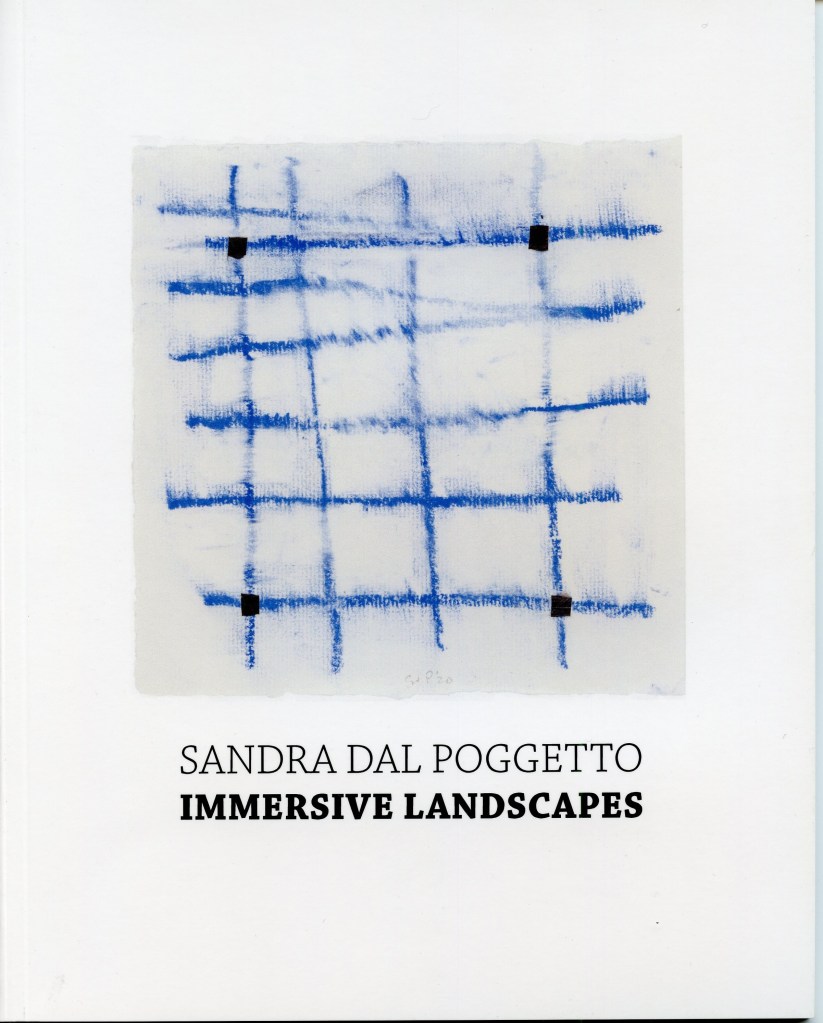
“While Dal Poggetto’s marks concentrate the richness of experience, her recent works are her most expansive to date. In particular, her American Fork paintings—both in physical scale and through the import of their content—stand as the apotheosis of her ongoing exploration. In paintings as large as nine feet square (see American Fork No. 15, 2016-2017), Dal Poggetto stretches far beyond the limitations of the ‘picture window’ of classical landscape painting. Perhaps that traditional format reminds her too much of the sheet of glass that descended to separate her, seemingly irrevocably, from her beloved Sonoma landscape. . . .
from the essay, “To Restore a Wealth that is Wild: Sandra Dal Poggetto’s Immersive Art,” by Rick Newby; originally published in High Desert Journal 33 (Winter 2022).
Through the rigor of her art, [Sandra Dal Poggetto] seeks to offer new ways of perceiving, and being with, this actual physical world we share. . . . these tender, expansive, unsettlingly gorgeous works create a poetic space—both spiritual and political—that can help us to live more fully.“
Provocative Clay
(Sheboygan, WI: John Michael Kohler Arts Center, 2010 [digital version]/2022 [print version])
By Lena Vigna, Jo Lauria, Leslie Umberger, Beth Lipman, Rick Newby, and Carmen Devine
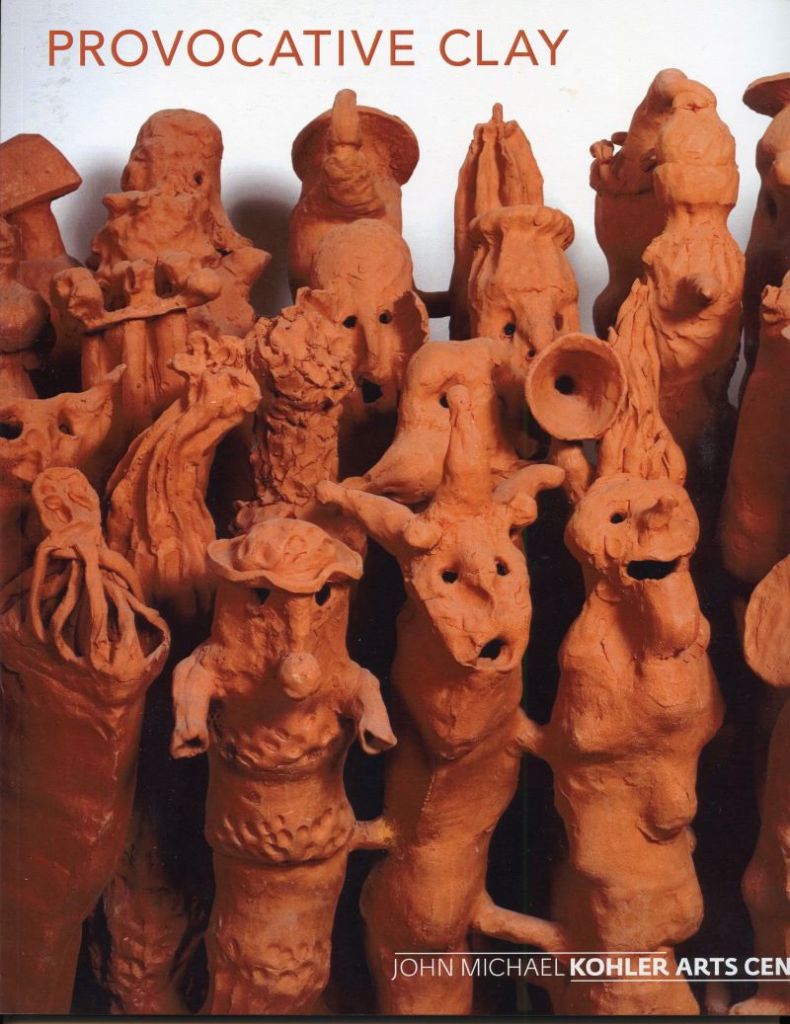
“In this time we call the postmodern, the ceramic arts have grown increasingly, even wildly, diverse. Since the 1950s, gallery-goers have often encountered handcrafted pots of undoubted utility alongside adventurous ceramic sculptural works that (more-or-less comfortably) straddle craft and fine art traditions. The American artists Jerry Bennett and Bean Finneran—and their works featured in Pushing the Limits at the John Michael Kohler Arts Center—stand at the sculptural end of this continuum. And yet their “seed jars” and “cones,” “rings,” and “cores” challenge our notions of what ceramic sculpture should be. By their apparent fragility, they leave us musing: How are these structures built? What do they signify? How do these artists achieve their startling effects, of near-transparency, of apparent randomness that still achieves a pleasing order, of lightness in the face of an obdurate gravity? At opposite ends of the North American continent (Bennett in Philadelphia and Finneran on San Francisco Bay), the two artists explore natural and cultural forms in ways that are kindred and yet radically dissimilar. Each creates his or her work by assembling multiple objects. One sees himself firmly within the ancient and honorable tradition of the ceramic arts, while the other avows that she is simply a contemporary sculptor who happens to use clay. One, stripping almost all color from his work, seeks the perfect shade of white; the other saturates her stacks of “curves” with impossibly vibrant colors. Their mutual achievement is to refresh the art of clay, bringing to this most mutable of materials qualities of whimsicality, inventiveness, and an undeniable sense of play, together with an almost spiritual aura—lovingly built into the works through untold hours of patient labor.”
from the essay, “Jerry Bennett and Bean Finneran: Pushing the Limits,” by Rick Newby
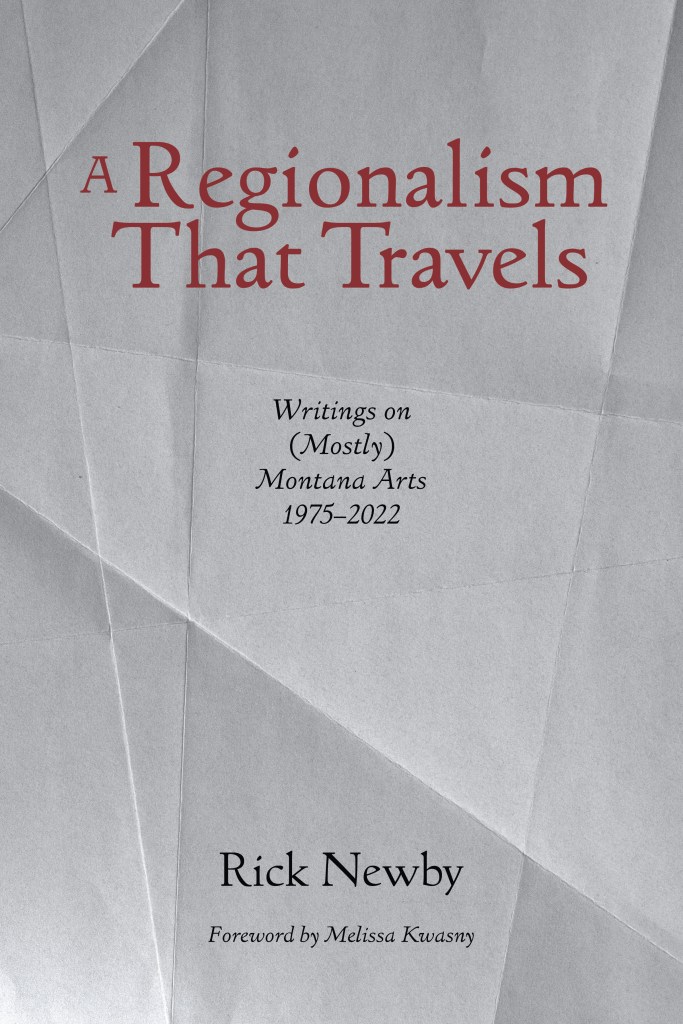
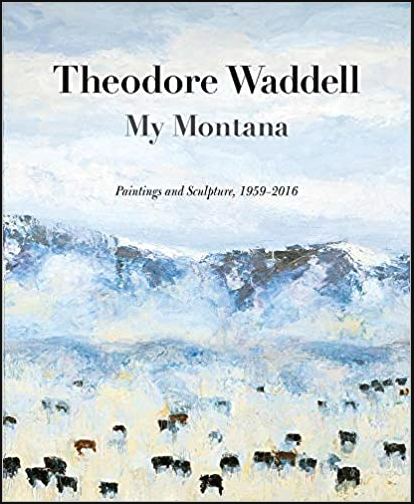
Theodore Waddell—My Montana: Paintings & Sculpture, 1959-2016
(Helena, MT: Drumlummon Institute, 2017).
By Rick Newby (with contributions by the Hon. Pat Williams, Robyn Peterson, Bob Durden, Donna Forbes, Mark Browning, Gordon McConnell, Paul Zarzyski, Scott McMillion, Patrick Zentz, William Hjortsberg, Greg Keeler, and Brian Petersen)
Recipient, High Plains Book Award, Art/Photography, 2018.
Patricia Vettel-Becker, Montana the Magazine of Western Hisotry, Winter 2017
“Rick Newby’s Theodore Waddell—My Montana: Paintings and Sculpture, 1959-2016 is not a typical art book, but then again, its subject is not a typical aritst. Neither artist biography, art criticism, nor catalogue raisonne, Newby’s work interweaves elements of each, crafting a serious, yet intimate, and often humorous, portrait of a Montana artist as singular as the book itself. . . . . Although a biographical homage to one of Montana’s most renowned artists, Newby’s book also contributes to a growing body of scholarship examining the history of modernism in the West . . . this book is a literary gem.”
“For Big Sky Journal, the new consideration of the life and work of Ted Waddell by Rick Newby is one of the most significant publishing occasions of the year.”
Corinne Garcia, Big Sky Journal, Art Issue, 2017
“As its title suggests, Theodore Waddell–My Montana: Paintings and Sculpture, 1959-2016 , impressively unites three topical threads: it is biography, Montana history, and art history in one. Via the life and artwork of Theodore “Ted” Waddell, the author Rick Newby and 12 contributors remind us of the rich history and living legacy of the arts in Montana. . . . Meticulously laced with primary sources, oral histories, and illustrations, the book . . . presents a breadth of context for understanding Waddell’s art and biography”
Jennifer R. Henneman, Pacific Northwest Quarterly, Spring 2018
On the Chinese Wall: New & Selected Poems, 1966-2018
(Helena: Drumlummon Institute, 2018)
By Roger Dunsmore, Edited and with an introduction by Rick Newby.
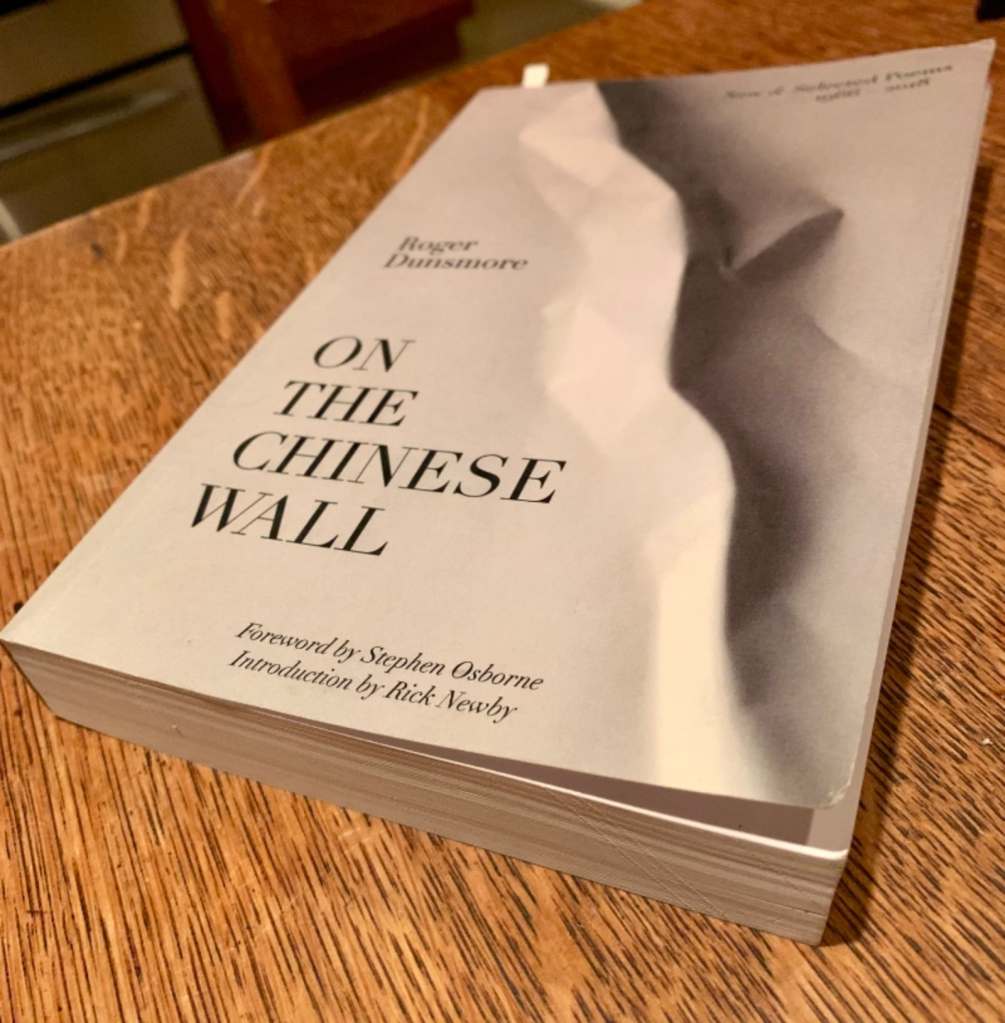
“Roger Dunsmore invokes Gary Snyder and Lewis Thomas as epigraphs to this impressive and wide-ranging collection, but they aren’t the only guiding spirits: Lucille Clifton, Ikkyu, Lao Tzu, Werner Herzog, Eckhart, and various ‘everyday folks’ from a variety of walks of life—as well as a menagerie of animal spirits—also inhabit and inform these poems. Although the poems speak from a sensibility ethically inhabiting and in loving relation with peoples and creatures from the entire planet, Montana is the hearth around which Dunsmore’s poems come into being— sometimes like slowly unfolding stories around a slow-burning fire (with that yarn-spinning talent of mastery), sometimes like lyrical bursts and fever (with a powerful emotional core), sometimes like softly spoken observations that nudge a reader toward a more deliberate inhabitation of the world.”
Tod Marshall, Gonzaga Professor and former Washington State Poet Laureate
“Roger Dunsmore’s collection On the Chinese Wall runs as deep as the river of time. Ways of seeing the world are renewed and retooled. These poems seem in tune with the hum of ancient spirits. The old earth sings.”
Debra Magpie Earling, author of Perma Red
West of True: Jane Waggoner Deschner & Gordon McConnell
(Fallon, NV: Churchill Arts Council, 2014)
By Rick Newby & Marci Rae McDade
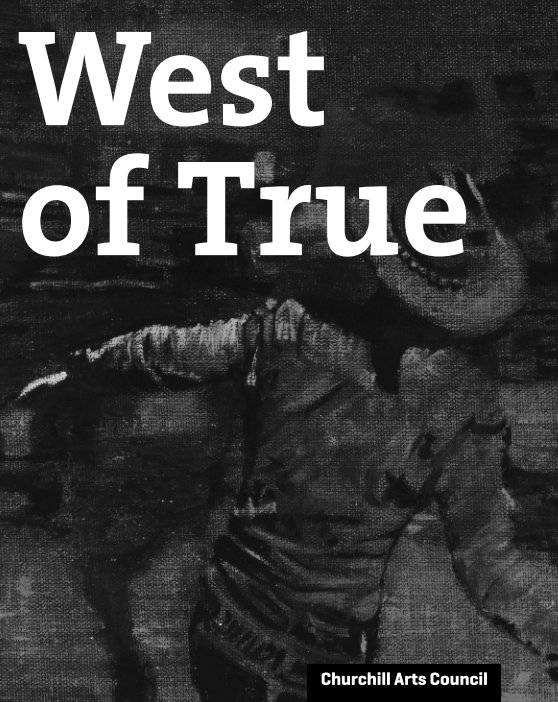
“Montana painter Gordon McConnell, in his haunting new exhibition, West of Everything: New and Selected Paintings, recapitulates real and imagined scenes from the classics of Western film. Such scenes have been McConnell’s chosen imagery for the past thirty-odd years, but in his most recent work, something fundamental begins to change. From the start, McConnell’s work has been intellectually challenging and rendered with considerable wit, embodying a corrosive vision. In the recent work, the changes are subtle and emotionally powerful. There is a mournful or retrospective quality, a sense that this work is no longer primarily playful or satiric, but rather constitutes an extended elegy for a lost time and place, a western culture that, however flawed, deserves if not our respect, at least our affection.“
from the essay, “Gordon McConnell: The Past That Was,” by Rick Newby
The Whole Country was . . . “One Robe”: The Little Shell Tribe’s America
(Great Falls/Helena: Little Shell Tribe of Chippewa Indians of Montana/Drumlummon Institute, 2013)
by Nicholas C. P. Vrooman. Edited by Rick Newby.
Out of print. Rare.
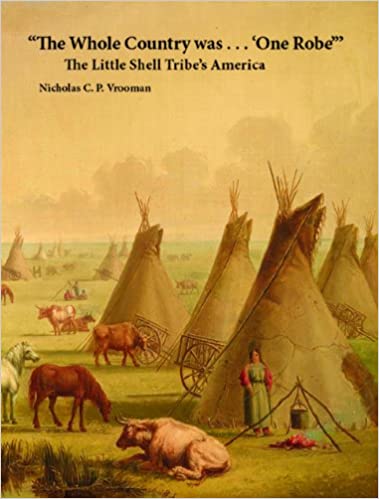
“This is the first book written on the Montana Little Shell people. It’s been a long time coming to understand the course of the lives of our people and to teach our children about our historical past. Nicholas has done a fantastic job with pulling the complicated history together and how the people have survived these last 100 years. It is a story that brings all the elders’ stories together with the influences of injustices that affected our people.”
Judy Jacoby, Little Shell tribal member
“this is a wonderful, intelligent, extremely well-written and thought out history of a people whose past was obscure until the author illuminated it so brilliantly. he is a remarkable researcher. the book is itself handsomely produced. the illustrations, photos and reproductions of a wide variety of paintings are a pleasure to look at.”
Charles Sherry
“The Whole Country was . . . ‘One Robe’ [is} the definitive history of the Little Shell tribe of Métis in Montana. And the life work of Nicholas Vrooman, folklorist, historian, and defender of Métis rights. With this one book, Nicholas made their complex history accessible to the rest of us. And, he continued making it accessible through presentations and interviews. And, through his genuine passion for and love of a culture not his own.”
Barbara Pepper Rotness, Montana Historical Society Research Center
Matter + Spirit: Stephen De Staebler
(San Francisco: Fine Arts Museums of San Francisco/University of California Press, 2012)
By Timothy Anglin Burgard, Dore Ashton, & Rick Newby
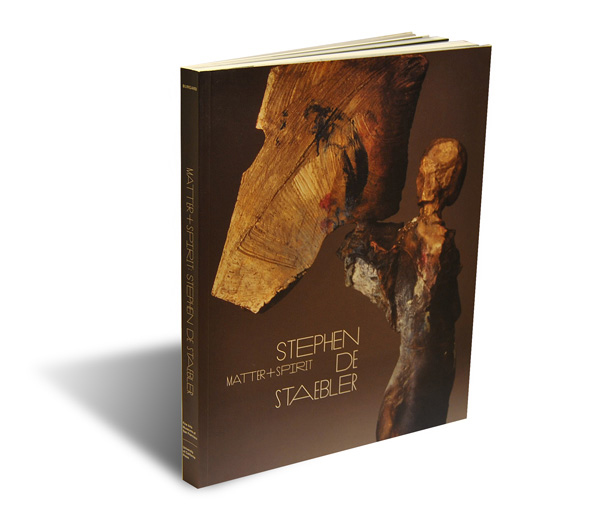
“An excellent catalogue [for the exhibition, Matter + Spirit: Stephen De Staebler, at San Francisco’s De Young Museum], edited by the show’s curator, Timothy Anglin Burgard, features gracefully written, illuminating essays by critics Rick Newby and Dore Ashton that provide esthetic, historical and psychological perspective into the man and his art.”
DeWitt Cheng, Huffington Post, March 2012
“The layered artistic message proffered by De Staebler and his work is not always interpreted well by others. {Rick] Newby, however, discusses both DeStaebler’s sculptural accomplishments and spiritual universalities in a gracious manner that is a tribute to the artist. He skillfully translates the essence of De Staebler’s work into this accessible text, presenting both the anguish but also the vitality of De Staebler’s work.”
Nancy M. Servis, Ceramics: Art & Perception, 2013
Jazz Icons: Wood Engravings, Woodcuts & Paintings by James Gilbert Todd
(Helena, MT: Holter Museum of Art, 2012)
By Rick Newby, James Todd, & Yvonne Seng
Out of print
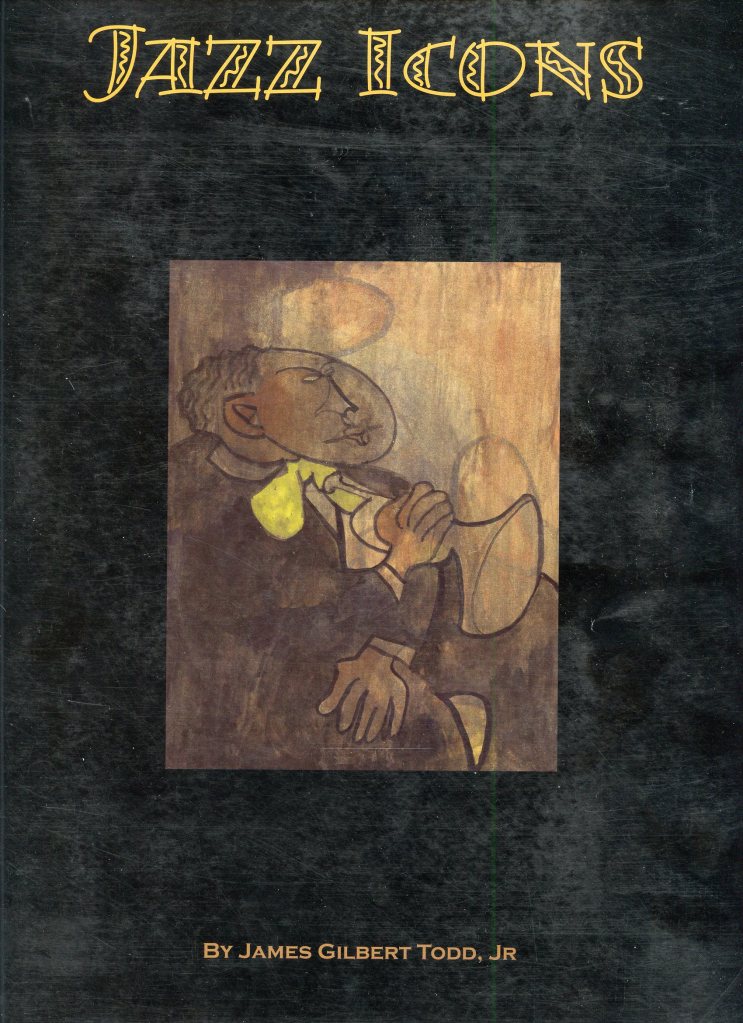
“What is it about Jim Todd’s jazz engravings that renders them so captivating, more so even than his portrait series honoring printmakers (Rembrandt, Jacques Callot, Picasso, Hannah Höch, José Posada) or world changers (Galileo, Charles Darwin, Gandhi)? There is something profoundly grave and dense about these images of jazzmen and -women, a bodying forth of lives devoted to exuberant and soulful creativity in the face of very real obstacles: of racism, sexism, and plain old philistinism. This sense of lived experience, hard earned and always passionate, may well come from Jim Todd’s early love of jazz, his personal engagement as a young jazz drummer, his sense of a vast world opening up on the fleet notes of Louis Armstrong’s trumpet (whom he might have heard at the Great Falls Civic Center, ca. 1950).“
from the essay, “Montana Improvisations: Jim Todd’s Jazz Wood Engravings,” by Rick Newby
Joseph Baráz: Paintings & Sculpture, 1990-2011
(Helena: Zadig, LLC, in association with JFG Temporary, 2011)
By Rick Newby.
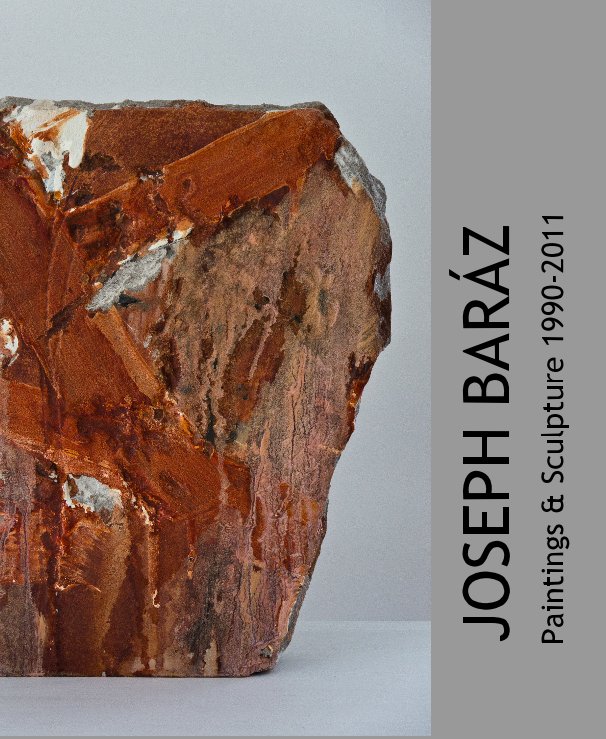
“In a high-ceilinged garage attached to a Victorian brick carriage house hidden away in a leafy neighborhood somewhere in the western United States, one might – if one is lucky – stumble upon a vast and unruly archive of stone, lead, wood, and plaster works of art. Created by Hungarian-born, Montana-based artist Joseph Baráz, these sculptures seem relics of a sensibility shaped by many cultures and eras; they feel timeless and yet profoundly of this historical moment. Among Baráz’s works, you will find a few classically inclined figures, but most are powerfully roughhewn expressions, partaking of a strain in late modern sculpture and painting that blends acute attention to materials and textures with a conscious rejection of refinement in favor of something more elemental, almost folkloric. One of Baráz’s favorite words is “humble,” and his works, small scale (for the most part) and highly tactile, achieve their humility without giving up an almost spiritual intensity.”
from the essay, “The Beauty of Decay,” by Rick Newby
Persistence in Clay: Contemporary Ceramics in Montana
(Missoula, MT: Missoula Art Museum, 2011)
By Hipólito Rafael Chacón, Rick Newby, and Stephen Glueckert
Out of print. Rare.
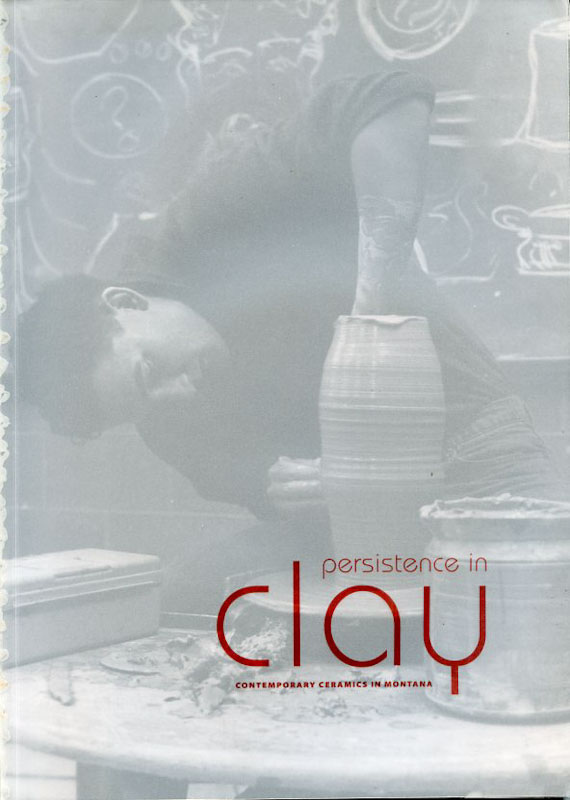
“From a Montana point of view, perhaps the most beautiful aspect of the Archie Bray Foundation contagion has been the enrichment of Big Sky country’s ceramic culture. Thirteen of the nineteen artists in the current exhibition, Persistence in Clay: Contemporary Ceramics in Montana, are former or current Bray residents, most of whom first came to Montana specifically to immerse themselves in the Bray experience—and decided to stay. Missoula, Bozeman, Helena, and the Flathead have flourishing ceramic communities, and Montanans are truly fortunate to have local access to a panoply of world-class ceramic objects, whether they are superbly handcrafted pitchers, cups, and bowls (by such national figures as Sarah Jaeger, Josh DeWeese, or Julia Galloway), or astonishing sculptural expressions (by such luminaries as Richard Notkin, Robert Harrison, Adrian Arleo, and Beth Lo). In 1966, David Shaner claimed, “What New York is in communications, Hollywood in the film industry, and New Orleans in jazz, Helena is becoming in the field of creative pottery. In this field you can’t go any higher than the Archie Bray Foundation.” At the time, Shaner may have overstated his case, but by the second decade of the twenty-first century, his claim rings true.“
from the essay, “Montana’s Archie Bray Foundation for the Ceramic Arts: Origin & Impact,” by Rick Newby
In Poetic Silence: The Floral Paintings of Joseph Henry Sharp
(Tucson, AZ: Settlers West Gallery, 2010)
by Thomas Minckler. Foreword by Brian Dippie. Edited by Rick Newby
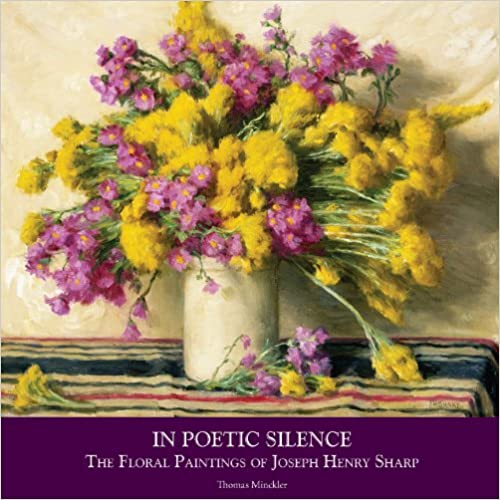
Brian Dippie, foremost authority on the art of the West, salutes In Poetic Silence as a “pathbreaking study”. The first monograph devoted exclusively to Joseph Henry Sharp’s florals, this masterful work reveals Sharp’s best-kept secret: that in the course of his long career, he created as many as 400 floral paintings. Beautifully written by Thomas Minckler, this 246-page volume contains more than 100 magnificent reproductions of Sharp’s finest floral paintings.
Splendid on a Large Scale: The Writings of Hans Peter Gyllembourg Koch, Montana Territory, 1869-1874
(Helena: Bedrock Editions/Drumlummon Institute, 2010)
Kim Allen Scott, editor. Preface by Rick Newby
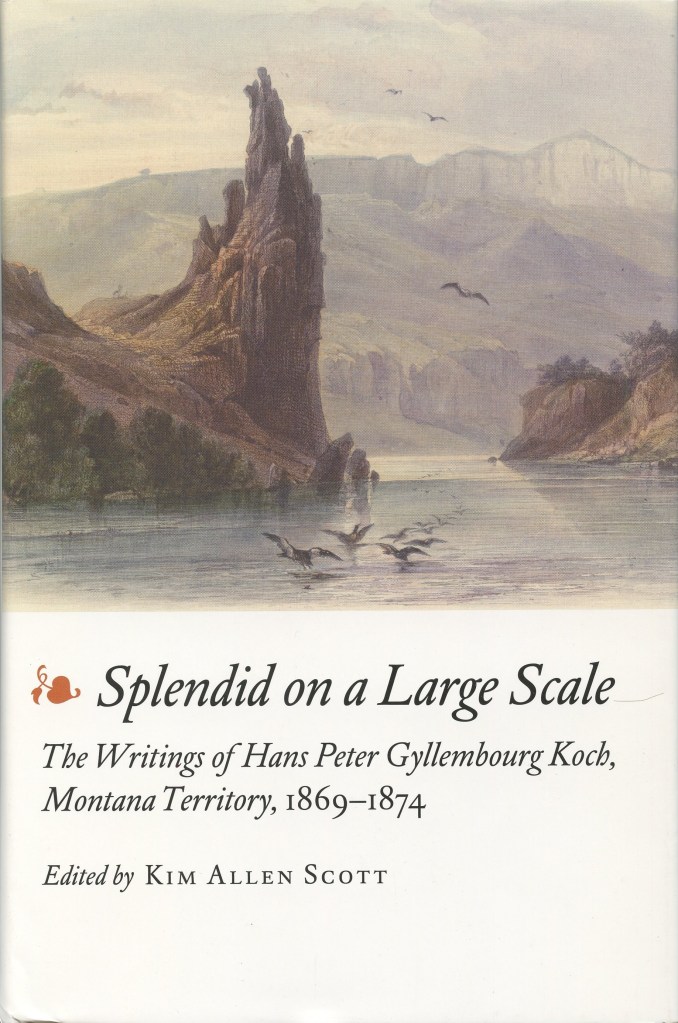
“While [scholar Carl Cone’s] claim (that cowboy culture played no role in the building of the West) can certainly be disputed, [he] was right about Hans Peter Koch possessing a unique perspective on the character of the emerging frontier. Now, nearly seventy years after Cone began his work on these diaries and letters, the present volume, Splendid on a Large Scale: The Writings of Hans Peter Gyellembourg Koch, Montana Territory, 1869-1874, superbly edited by historian Kim Allen Scott, brings us a voice, alternately terse and eloquent, that offers testimony to a life lived in diligent pursuit, not only of material success, but also of a deep understanding – scientific, historical, and literary – of the place this Danish immigrant had chosen as his home.
Peter was not a bourgeois defined solely by his respectability and gentility. He embodied, in fact, the combination of rough and refined that gave the emergent EuroAmerican culture of the Northern Rockies its tension and savor. He had, after all, started out his time in Montana as a woodhawk on the Missouri, cutting fuel for the steamboats that plied the great river, and he was a trader at an isolated post on the Musselshell before he became a ‘substantial” banker. Like his fellow Montanans Granville Stuart and James Fergus, he was a classic western bookman, in love with this wild new country and, at the same time, passionate about the knowledge (and pleasure) to be found in books. And like Stuart and Fergus, he was an avid collector.”
from the preface, “Truer to History: Bookishness as a Western Way of Being,” by Rick Newby
The Art of Barry Hood
(Helena: Holter Museum of Art, 2010)
by Rick Newby and Brandon Reintjes
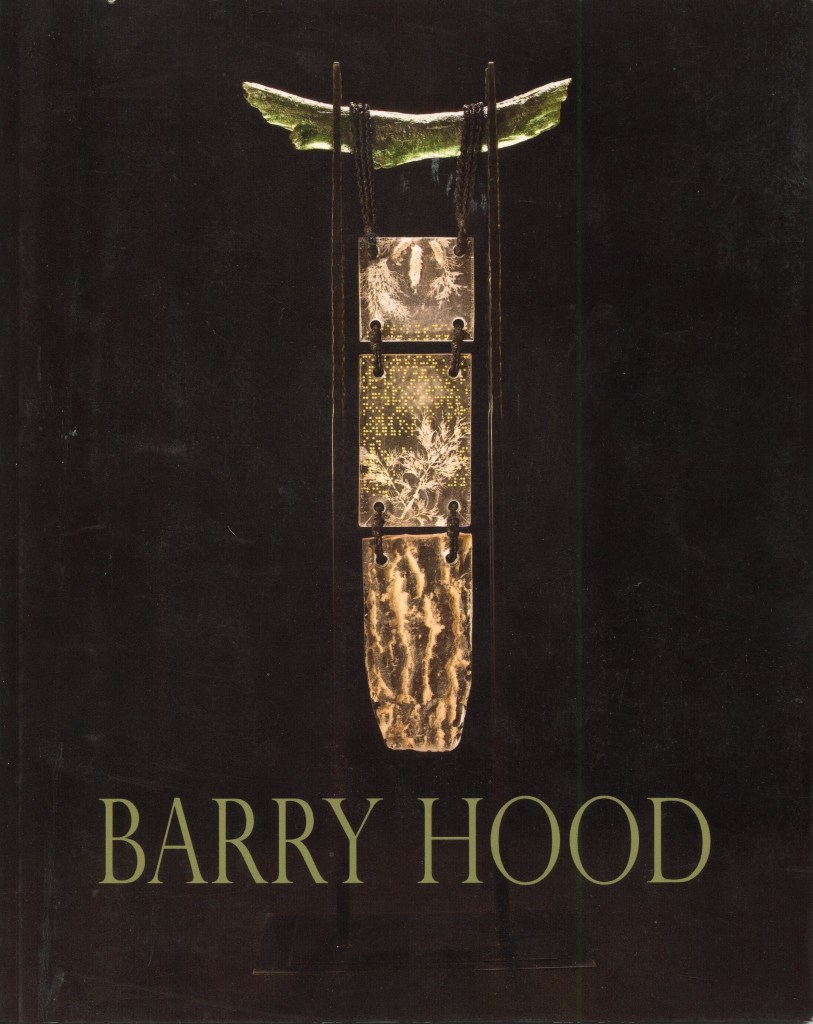
“From the beginning of his immersion in glass, Montana artist Barry Hood has focused his energies on depicting, echoing, articulating, and interpreting natural images, forms, and forces. Grounded in the Montana landscape, Hood is drawn to simplicity and purity, to vast spaces, states of water, fragments of plants. . . . [M}any of Hood’s works have little of the traditional ‘beauty’ associated with glass objects. They are not refined, smooth, or instantly eye-dazzling. Instead, they remind the viewer of the results of transformative natural processes, of volcanic rock or ice riven by sun and frozen again. They resemble the remains of something as yet undiscovered. And as manmade objects, they suggest an affinity with Japanese, and particularly Zen, aesthetics, in which spontaneity, earthiness, apparent rusticity, imperfection, even “corrosion and contamination” are found in works that are spiritually rich and that embody a quiet beauty.”
from the essay, “Abstracted from the Earth: The Art of Barry Hood,” by Rick Newby
Coming Home: A Special Issue [of Drumlummon Views] Devoted to the Historic Built Environment of Butte & Anaconda, Montana
(Helena: Drumlummon Institute/Montana Preservation Alliance, 2009)
Patty Dean, guest editor. Rick Newby, editor-in-chief.
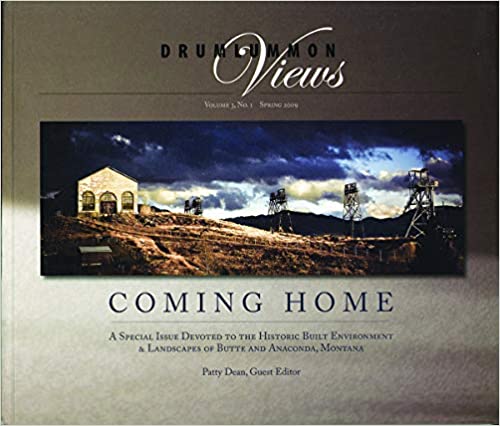
“Perhaps the most scrutinized and documented of Montana cities,” editor Patty Dean writes, “Butte and Anaconda possess great material and cultural incongruities that continue to intrigue and beguile: natural beauty versus industrial landscape, great wealth versus subsistence and poverty, ornate buildings designed by nationally known architects versus alley hovels, urban density versus the void of the Berkeley Pit.”
Coming Home sheds fresh light on the industrial and domestic landscapes that make Butte and Anaconda so distinctive. The issue features essays, portfolios, and reprints that make accessible such underutilized/ forgotten historic resources as an early 20th-century newspaper series profiling “queer spots” in and around Butte and Anaconda (e.g. Chinese gardens, the “Assyrian colony” on East Park, the Cree village on the Butte Flats), historic photographs of sanitary conditions in Butte’s working class neighborhoods, and a 1907 article on arts and crafts homes in Butte.
In addition, the issue offers new research on the landscape and architecture of Butte and Anaconda as a manifestation of dominance and power, multi-family building forms in Butte, and Butte’s iconic mine headframes.
Robert Harrison: The Architecture of Space
(Helena: Drumlummon Institute/Holter Museum of Art, 2009)
By Rick Newby & Glen R. Brown
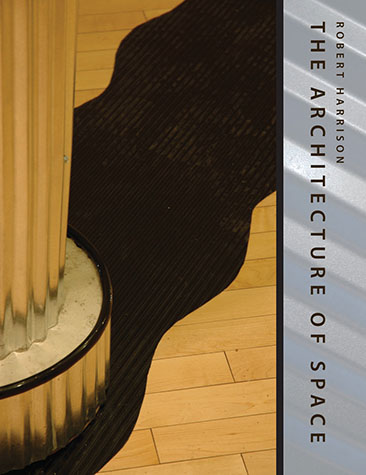
“Like Robert Harrison’s A Potter’s Shrine at the Archie Bray Foundation, his gallery installation Art/Architecture (Holter Museum of Art) was an ideal site for meditation or communion, more clearly a sanctuary or sanctified space (for a religion both comfortingly familiar and inextricably alien) than any of his earlier installations, and yet it invited widely varying interpretations. Was it the playhouse of a wise and eccentric child? A place for assignations, the passing of notes and furtive kisses? An educational display at a perverse county fair? A folly in a garden? Or a ‘reliquary not of saints’ bones,’ as French theorist Roland Barthes has written, ‘but of [the artist’s] pleasures’? The work’s ambiguity, its ‘transparency,’ as Harrison likes to call it, cried out for analogies; as Barthes writes, ‘Metaphor is the only way of naming the unnamable.’”
from the essay, “Robert Harrison’s Architecture of Space,” by Rick Newby
Stephen De Staebler
(Chicago: Zolla/Lieberman Gallery, 2008)
By Rick Newby
Out of print. Rare.
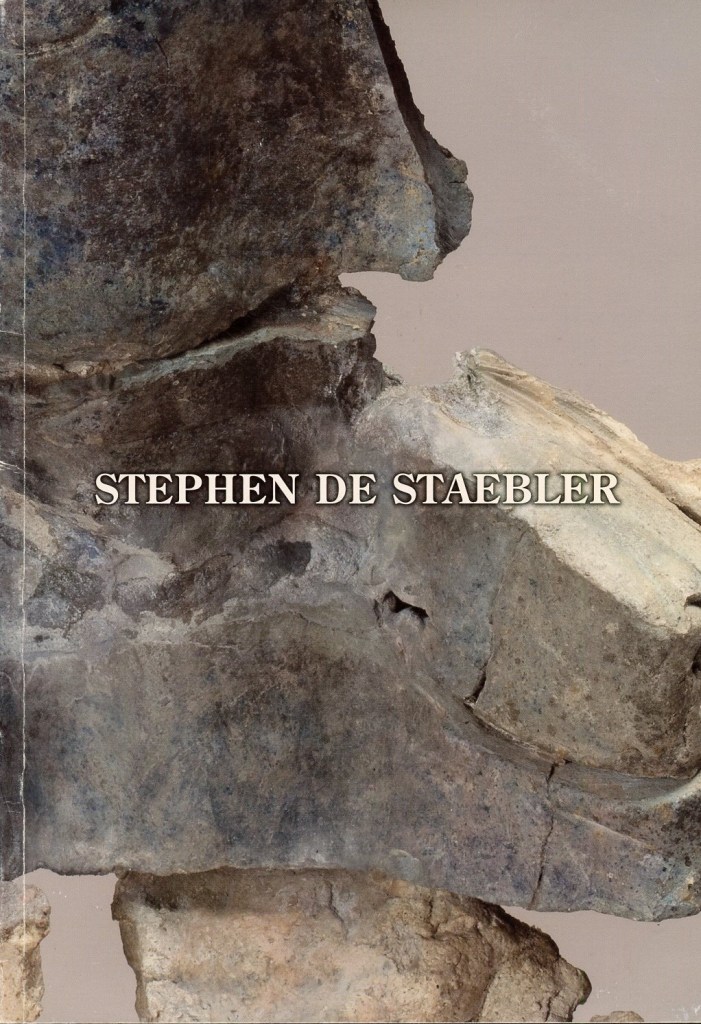
“His work may appear timeless, but Stephen De Staebler stands in a profoundly modernist tradition, one in which artists have explored and recontextualized, shattered, and reassembled their materials in new, powerful, and often unsettling ways. The branches of this tradition most closely aligned with De Staebler are the California Funk and Assemblage movements. But unlike many of the Funk and Assemblage artists, De Staebler is drawn, not to savage satire, direct political commentary, or raucous wit (like Robert Arneson or Ed Kienholz), but to the deepest elements of human experience: loss and rebirth, entropy and energy, grief and healing. His works possess an unmistakable gravitas, even at their most graceful and celebratory.
“Despite his self-described “ornery individualistic approach,” De Staebler has acknowledged numerous debts, not only to his mentor Peter Voulkos, but also to the rugged bluffs of his native Indiana, to the frontality of Egyptian sculpture, and especially to Alberto Giacometti, for whose somber works he continues to avow a deep affinity.
“’Only that which does not cease to hurt remains in memory,’ wrote Friedrich Nietzsche in The Genealogy of Morals. To be in the presence of Stephen De Staebler’s recombinant figures – his shattered shinbones, split torsos, and flared thighs, his monstrous thorax – is to participate in a profound remembrance, to dwell in the pain of mortality and, simultaneously, to experience the power of this American master’s healing art.”
from the essay, “Wrested from the Earth: The Recombinant Poetics of Stephen De Staebler,” by Rick Newby
Sketches Begun in My Studio on a Sunday Afternoon and Completed the Following Day Near the Noon Hour on the Lower Slopes of the Rocky Mountains
(Berkeley, CA: Editions Koch, 2008)
By Rick Newby
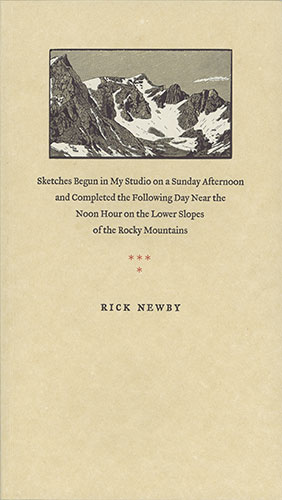
“Rick Newby is a gifted Montana poet who has responded lyrically, thoughtfully, deeply to Montana’s history, landscape, and contemporary lives. His poetry blends a down-home Montana sensibility with a highly sophisticated sensitivity to European, Asian, and other traditions. The ease with which he blends these seemingly conflicting voices speaks to a playful, confident writer who knows that a Montanan can be every bit as cosmopolitan and profound as a writer from New York, Paris, or Beijing.”
Ken Egan, former Executive Director, Humanities Montana
Richard Notkin
(Davis, CA: John Natsoulas Press, 2008)
By Rick Newby
Out of print. Rare.
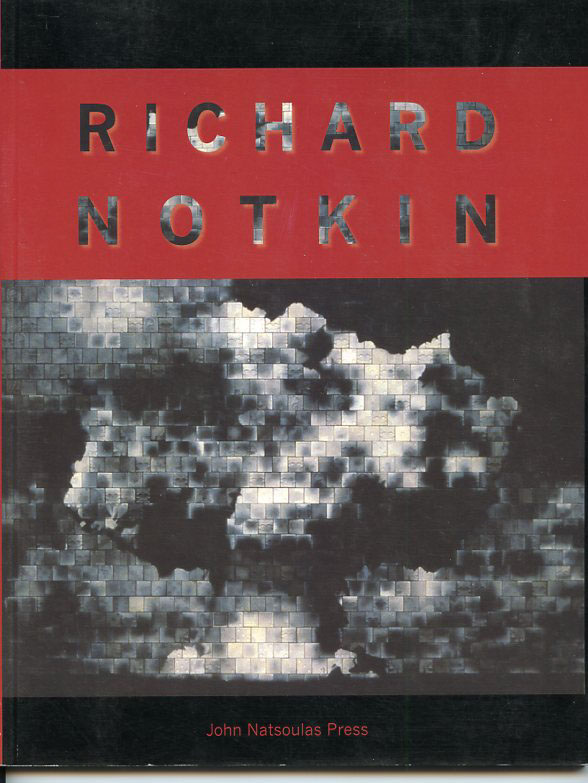
“Like his avowed models, the Goya of the Disasters of War etchings and the Picasso of Guernica, Richard Notkin seeks to make a difference through powerful imagery. And astonishingly, the teapot form has proven a near-perfect vehicle for his complex and increasingly universal expression. It has held his attention since 1976, and between 1983 and 1994, he dedicated nearly all of his artistic effort to fashioning a series of remarkable teapots—slipcast but each unique—that represents one of the most sustained and committed bodies of work in contemporary world ceramics. Many of Notkin’s teapots incorporate elements from his personal iconography: nuclear power plant cooling towers, chess boards and gambling dice, H-bomb mushroom clouds, human skulls and brains, light bulbs, fire hydrants, stacked wooden crates, pyramids, oil barrels, peanuts in the shell. Each teapot is a beautifully coherent assemblage of a particular set of these icons. Improbable combinations, radical shifts in scale (a mushroom cloud atop a human skull), and sardonic humor (both in imagery and in their titles; witness, for example, Pyramidal Skull Teapot: Military Intelligence I) recall the strategies of disjunction and defamiliarization deployed in the political photomontages of John Heartfield and Hannah Hoch.“
from the essay, “Teapots Against the Darkness: The Archievement of Richard Notkin,” by Rick Newby
Long Lines of Dancing Letters: The Japanese Drawings of Patricia Forsberg
(Helena: Drumlummon Institute, 2008)
By Rick Newby
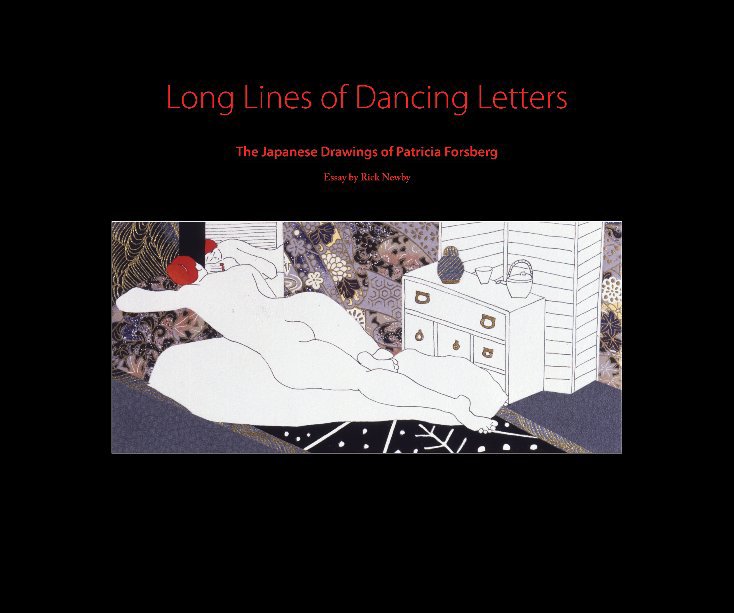
“[Patricia Forsberg] wrote of the tension in her earlier work between the ‘pursuit of freedom, choice, and space’ and the ‘inevitable taming and containment of the environment, animals, and our lives.’ That tension between freedom and containment, this modernity of spirit―the absolute nakedness of the work―is what takes Patricia Forsberg’s Japanese drawings far beyond mere imitation or even heartfelt tribute. In their exploration of the interior life of women today, These drawings are, quite simply, marvelous expressions of one artist’s allusive imagination, speaking across centuries and cultures with restrained feeling, quiet power, and a riveting sense of beauty all their own.”
from the essay, “Long Lines of Dancing Letters,” by Rick Newby
Drumlummon Views, the Online Journal of Montana Arts & Culture.
Print version. To order, go to https://www.blurb.com/b/480972-drumlummon-views-fall-2008
(Helena: Drumlummon Institute, 2008)
Rick Newby, editor in chief
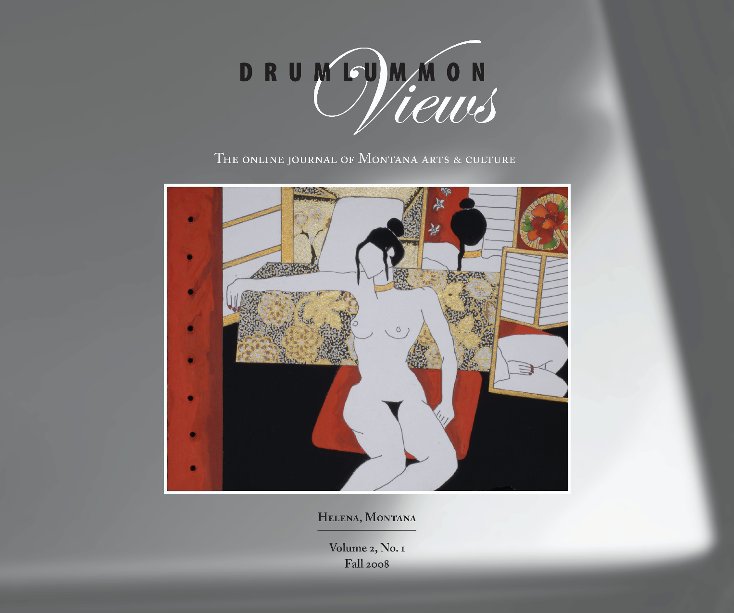
“I must say that I am impressed with [Drumlummon Views], a real cut above in what I am seeing from many online journals, not just in the look but in the range and quality of the contributions. Congratulations on a real step forward.
Carroll Van West, author of A Traveler’s Companion to Montana History.
“Rick Newby and Drumlummon Institute are engaging Montanans in eloquent and insightful discussions on the art and artists of our time and region. Nothing is needed more right now for a popular appreciation of contemporary art than such a development of ideas and vocabulary.”
Daniel S. Biehl, former curator, Paris Gibson Square Museum of Art, Great Falls, Montana.
Notes for a Novel: The Selected Poems of Frieda Fligelman
(Helena: Drumlummon Institute, 2008)
By Frieda Fligelman. Alexandra Swaney & Rick Newby, editors.
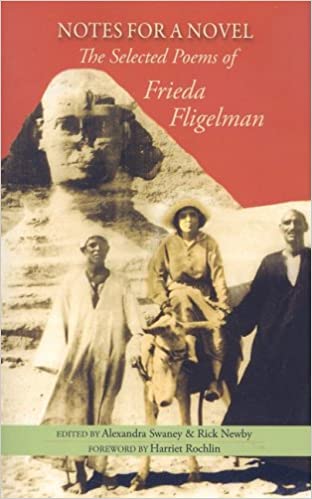
“Notes for a Novel bears witness to a western Jewish woman who thought deeply and felt passionately; to the strands of cultural and intellectual electricity in small towns throughout the American West; and to world travelers who find in their natal nests the happiness they’d failed to find elsewhere.”
Harriet Rochlin, author, A Mixed Chorus: Jewish Women in the American West, 1849–1924
Born and raised in Helena, Montana, Frieda Fligelman published only a handful of poems during her lifetime, but at her death she left behind a manuscript of 1,200 exceptional poems. Educated at Columbia and in Paris during the 1920s, Frieda Fligelman was a suffragist, translator, world traveler, advocate for human rights, and founder of the discipline of sociolinguistics.
Stephen Braun: Cause & Effect
(Davis, CA: John Natsoulas Press, 2007)
By Rick Newby, Sonja Burgal, and Janet & David Peoples
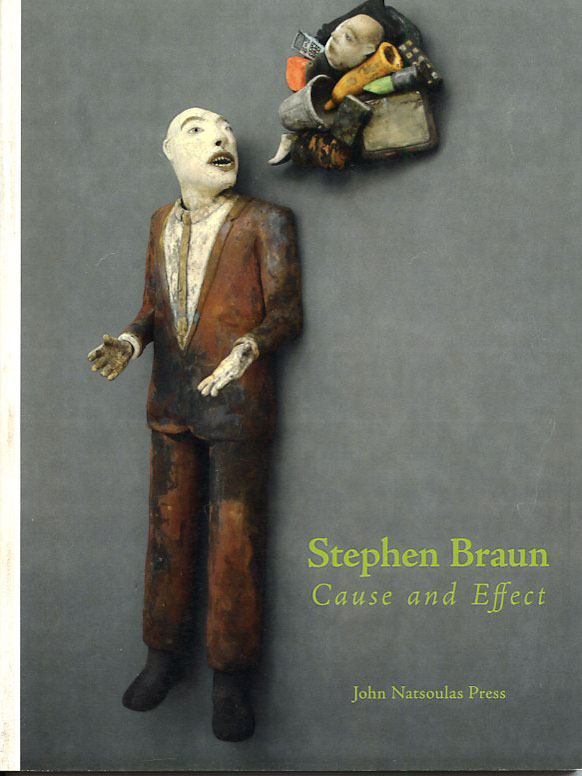
“Trained as an anthropologist at The University of Montana (where he also studied under ceramic revolutionary Rudy Autio and mixed-media sculptor Ken Little), Braun believes that each culture defines its reality through the construct of language. With his sculptures, he aims to ‘break culture down’ and offer unadulterated ‘hyper-perceptions.’ As a young artist, in an effort to shatter his own cultural projections, he fasted and deprived himself of sleep for days (in a kind of vision quest). Making his home on cattle and sheep ranches in southcentral Montana, at the foot of the Crazy Mountains (a ‘powerful spot’), he came to see the natural world as primary and began to incorporate animal imagery, especially deer, bears, and coyotes, into the imagined worlds of his monoprints and sculptures. While serving as visiting artist at Eastern Montana College (today, Montana State University-Billings), he connected with Crow and Northern Cheyenne students who shared his evolving perceptions about the primacy of nature and the destructive qualities of the dominant consumer culture.”
from the essay, “How Many Worlds? The Ceramic Art of Stephen Braun,” by Rick Newby
Dale Livezey: Paintings
(Reno, NV: Stremmel Gallery, 2007)
by Rick Newby
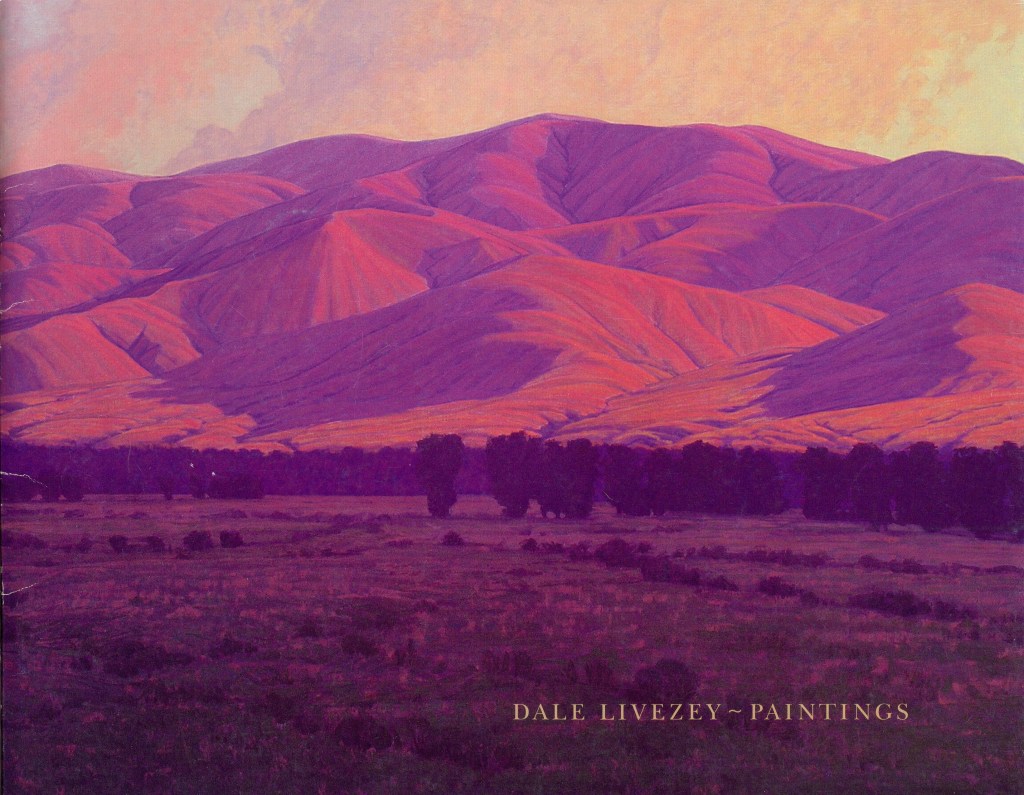
“Dale Livezey has turned away from the conventional rendering of detailed realism in favor of a dynamic and simplified vocabulary of planes and cubic forms (in the mode of [Maynard] Dixon) and a palette that sometimes stretches into heightened, “untrue” colors that express a truer reality (as with Wolf Kahn). . . . Unlike many painters of the West, Livezey is not interested in narrative. Rather than tell a story, he hopes to afford viewers emotions akin to those they might feel in front of a landscape on the Rocky Mountain Front, say, or at the foot of a tableland on the Montana prairie. He rarely includes any trace of the human in his paintings, “or even an animal,” because these traces of living beings suggest narratives that can distract from the purely visual impact. In fact, he recently said, ‘I have found that I’m more attracted to abstract painting than to representational work. The artist is not trying to tell you anything. The viewer is completely free. Personally, when I’m out in a beautiful place in nature, I feel a similar freedom.'”
from the essay, “Beckoned into Landscape: The Paintings of Dale Livezey,” by Rick Newby
Food of Gods and Starvelings: The Selected Poems of Grace Stone Coates
(Helena: Drumlummon Institute, 2007)
By Grace Stone Coates. Lee Rostad & Rick Newby, editors
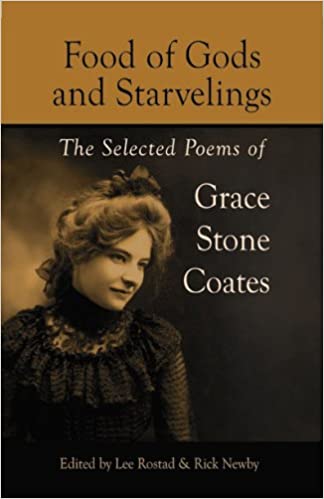
“Like a 20th-century Emily Dickinson, Grace Stone Coates writes of the world around her from the small town of Martinsdale, Montana, and her poetry is at once as sweeping and as precise as the prairie she lived on. With startling imagery and philosophical acuity, she explores the emotional landscape between women and men, mothers and daughters, small-town neighbors, and between a lonely woman and the landscape she lives in. Her voice rings clear, her eye is sharp, and her music is unerring.”
Caroline Patterson, editor, Montana Women Writers: A Geography of the Heart
New Works: Lawson Oyekan: Solstice Lip Series, Minneapolis
(Minneapolis, MN: Northern Clay Center, 2006)
By Rick Newby. Foreword by Emily Galusha.
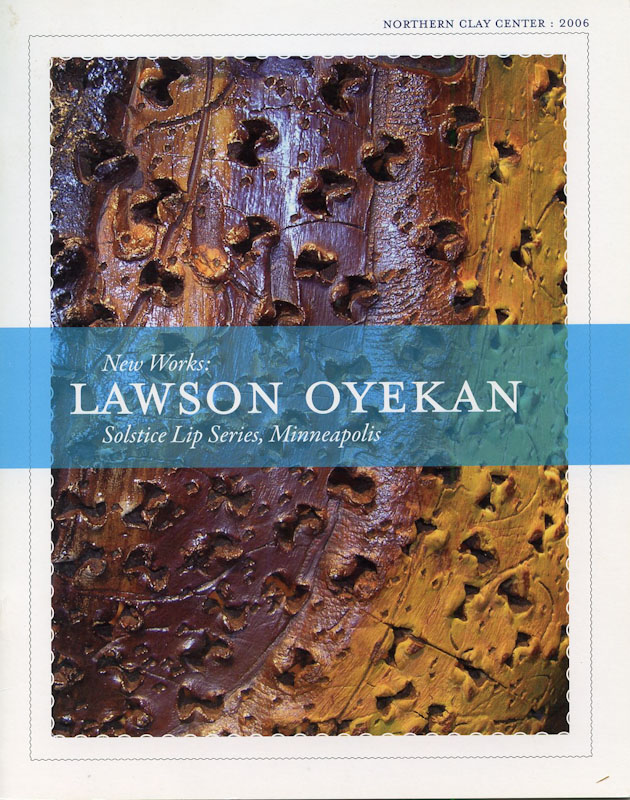
“Born in South London, but raised in Nigeria, Lawson Oyekan received his arts education at London schools and resides in the British capital today, while creating much of his work in a studio in Denmark. A true citizen of the world, he brings an exceptional breadth of experience and knowledge to his totemic sculptures. This complex admixture includes cutting-edge art theories and Yoruba drumming traditions, the surface qualities of West African termite mounds and a scientist’s knowledge of clay chemistry, a determination to heal in the face of entrenched racism and a sense of magic as the mastery of skills, in whichever field one engages.”
from the essay, “Lawson Oyekan: Healing Powers,” by Rick Newby
Rudy Autio: The Infinite Figure
(Helena: Holter Museum of Art, 2006)
By Marcia Eidel, Liz Gans, & Rick Newby
Out of print. Rare.
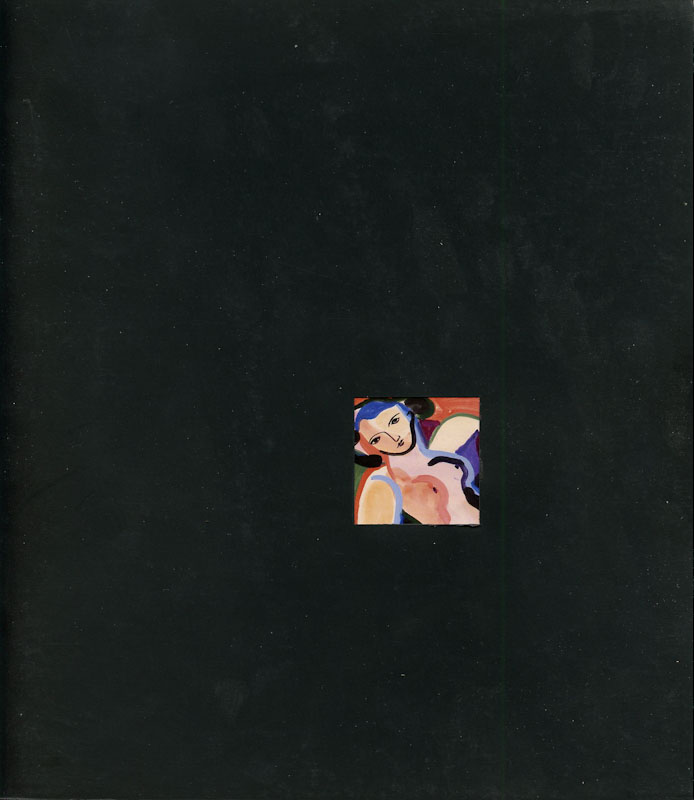
“The grace and vivacity of Rudy Autio’s painted figures and the energetic monumentality of his vessels produce a powerful and, at times, uncanny tension. Rudy speaks of wanting to ‘make an agreeable composition of form and surprise and color, dark and light, and pattern.’ But Rudy achieves much more than this. If we look closely at these floating nudes and their attendant horses (and occasional other beasts), we see scenes that, as often as they suggest ‘an Arcadian vision of the celebration of sensual beauty,’ call up darker themes, darker tonalities—of melancholia alongside rapture, of unspoken threats alongside delightful promises, of the inevitability of death alongside the miracle of fertility. One has the sense that, despite the gorgeousness of these leisurely and paradisiacal scenes, terror and loss and sorrow are never far offstage. This is as it should be. This tension, this sense of the complexity of existence, lends these works their power to hold us.”
from the essay, “Rudy Autio: Coming Home to the Figure,” by Rick Newby
The New Utilitarian
Examining Our Place on the Motherboard of Ceramics.
Catalog to National Council on Education for the Ceramic Arts (NCECA) Invitational Exhibition, Lewis & Clark College, Portland, OR, 2006,
By Rick Newby & Dana Plautz.
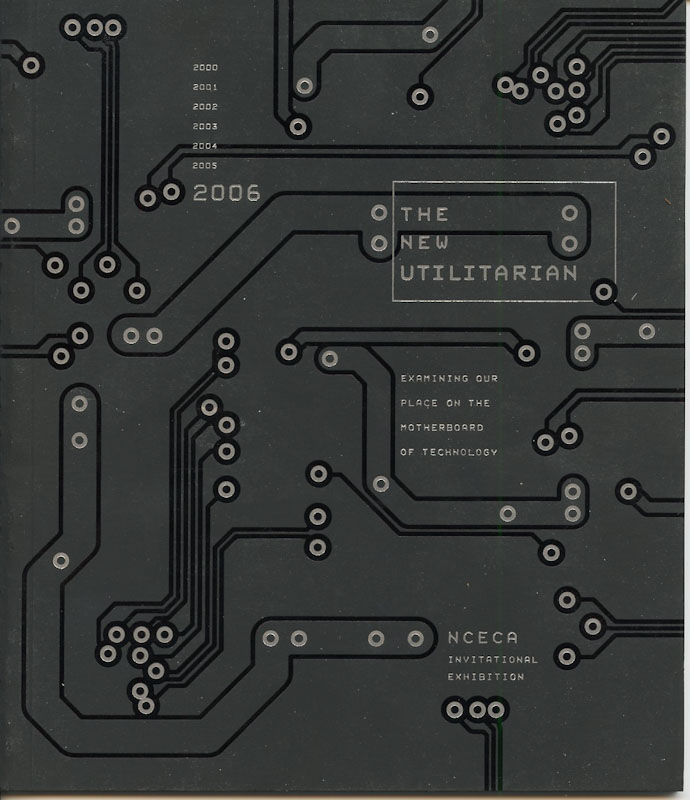
“The New Utilitarian showcases diverse and stimulating responses to the inescapable presence of new media. Some of the thirteen featured artists critique or interrogate technology. Others acknowledge the ubiquity of the new technologies, crafting out of the detritus of digital culture new metaphors for twenty-first century existence. Still others matter-of-factly turn to digital tools for the creation of their works, designing and in some cases fabricating their objects without direct intervention of the human hand. In general, there is little evidence of digital messianism. Instead these ceramists appear calm in the face of radical change, eager to try out new tools, but not overmastered by an insurgent faith.”
from the essay, ““Geometrical Codes/Material Bodies: Twenty-first Century Clay and the Hyperreal,” by Rick Newby.
Perforation
Tony Marsh, Jeffrey Mongrain, Mary Roehm, Marit Tingleff, Xavier Toubes
(Minneapolis, MN: Northern Clay Center, 2005)
By Rick Newby
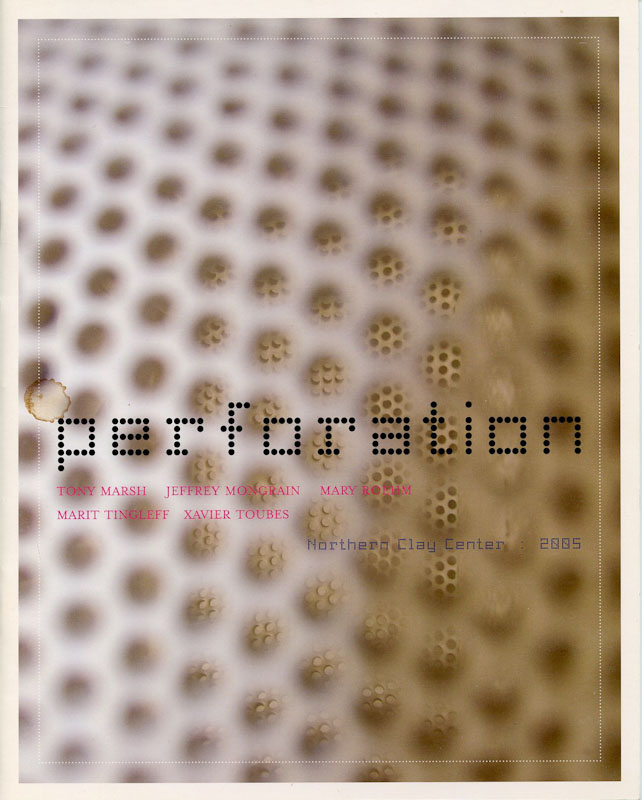
“To pierce, punch, or bore a hole or holes in; penetrate. To pass into or through something: The act of perforation has played—since ancient times, in many cultures—a role in the creation of works made of clay. And yet, despite its long history, ceramic perforation takes on new meanings, new tonalities, a fresh vibrancy in this first decade of the twenty-first century. As evidenced by the works of the five ceramic artists in this exhibition, perforation clearly remains an important strategy in the world of postmodern ceramics, driven by new (or revived) interest in such themes as ornament (condemned to oblivion by high modernism), dematerialization of the object, technology as boon and threat, the utilitarian versus the use-free, and the polarities of light/shade, positive/negative, presence/absence, inside/outside. Mary Roehm, Xavier Toubes, Jeffrey Mongrain, Marit Tingleff, and Tony Marsh each bring maturity, intelligence, and exceptional craftsmanship to their perforated works, but their approaches are radically different one from the other, emerging out of differing contexts, reflecting strikingly distinct sensibilities. Perforation is only one of a number of strategies these artists employ, but it clearly represents a central concern—in some cases, a full-blown obsession—for each of them.”
from the essay, “The Aesthetics of Disappearance: Ceramic Perforation in a Postmodern Age.” by Rick Newby.
Humor, Irony and Wit: Ceramic Funk from the Sixties and Beyond
(Tempe, AZ: Arizona State University Art Museum, Ceramics Research Center, 2004)
By Peter Held, John Natsoulas, & Rick Newby
“In the early 1960s, critic Donald Phelps championed the ‘Muck School,’ a strain in contemporary art that acknowledged, celebrated, and cracked jokes about the less-than-genteel dimensions of American culture. Phelps was characterizing a new species of taboo-shattering comedy best represented by Lenny Bruce, who played ‘a game of Russian roulette with absurdity, realism, and his audience’s feelings,’ and by the comics in Mad magazine, where any given panel was a ‘tapestry of uncontrollably screaming figures, demolished kitchenware, pools and rivulets of indescribable fluid. . . .’ This brand of ‘gritty, un-housebroken, garbage-happy’ art, rich in humor and the detritus of American consumer culture, found some of its most passionate and lasting expressions in the works of the Funk clay artists who first emerged in the mid 1960s in Northern California.”
from the essay, “Gritty and Un-housebroken: The Origins, Reception, and Dispersion of Funk Ceramics,” by Rick Newby
Crown of the Continent: The Last Great Wilderness of the Rocky Mountains
(Helena: Montana Nature Conservancy/Riverbend Publishing, 2004)
By Ralph Waldt. Edited by Rick Newby.
Winner, Benjamin Franklin Award for Science and Environment, Foreword Magazine’s Book of the Year for Nature, and a Montana Book Award Honor Book.
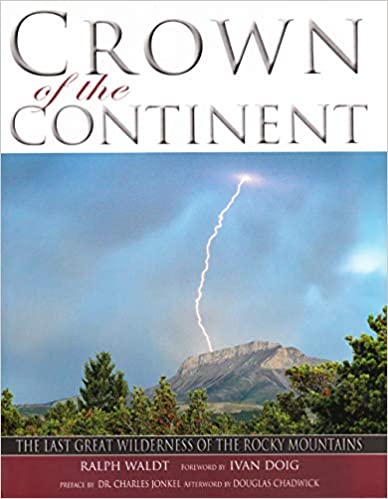
This award-winning title is an indepth look at the Crown of the Continent ecosystem, which covers more than 10 million acres in Montana and Canada. Author Ralph Waldt, a professional naturalist with The Nature Conservancy, spent more than 30 years exploring the area, including many years at the Conservancy’s Pine Butte Guest Ranch. In the book he vividly describes the area’s ecology, wildlife, and wild places. With 150 color photographs.
The Rocky Mountain Region
The Greenwood Encyclopedia of American Regional Cultures
(Westport, CT: Greenwood Press, 2004)
Rick Newby, editor
Selection, CHOICE Outstanding Academic Titles, 2005 Library Journal Best Reference Sources
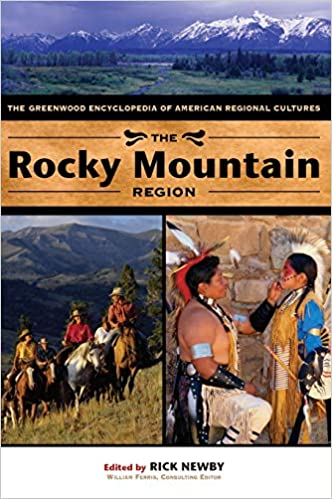
The Rocky Mountain region is where east meets west in America, where the western plains meet the Continental Divide. In this region, including Colorado, Idaho, Montana, Utah, and Wyoming, a multitude of cultural phenomena have grown. Rockies architecture includes Depression-era Government Rustic designs and also the parkitecture movement evident in Yellowstone National Park. Coyote folk tales and cowboy poetry contribute to regional lore, while the region’s religions have ranged from the shamanistic practices of the Utes, Nez Perce, and Coeur d’Alene to the flourishing of the Church of Latter Day Saints. Art of the American Sublime school as well as the fiction of Thomas McGuane immediately locate the Rockies, while fourteeners, ski town culture, and film festivals―from Sundance to Slamdance―make the region a favorite tourist destination. Rick Newby and contributors present a thorough and nuanced examination of the many cultural elements from throughout the wide reach of the Rocky Mountain region.
The New Montana Story: An Anthology
(Helena: Riverbend Publishing, 2003)
Rick Newby, editor
Showcasing the group of writers editor Rick Newby calls the “third wave of modern Montana storytellers,” this richly textured collection reveals that the “new” Montana story is many stories: some rural, others urban, some about deep roots, others about the loss of any sense of home, some boisterously funny, others sad beyond bearing. The New Montana Story includes such celebrated writers as Deirdre McNamer, David Long, Melanie Rae Thon, Ralph Beer, Debra Magpie Earling, and Maile Meloy, together with fresh new voices, each prodigiously talented.
“Poet and editor Rick Newby’s collection The New Montana Story surveys what he labels ‘the third generation of modern Montana storytellers” and handsomely attests to [the] aptness of the Big Sky’s robust literary reputation. . . . Anyone interested in the Montana literary scene must make a place for this worthy descendant of The Last Best Place. With this smorgasbord, we know literature thrives under the Big Sky.”
O. Alan Weltzien, Montana the Magazine of Western History, Spring 2004
Intimate Terrain: The Paintings of Michael Haykin
(Helena: Holter Museum of Art, 2003)
by Rick Newby
“For the past seven summers in Montana, Haykin has painted literally hundreds of landscapes, most small scale, depicting his favorite places. Always working in the field (en plein air) and with dispatch (he often completed two small canvases in a day), he developed a working method and visual vocabulary that led logically to the paintings of Intimate Terrain. There exist, however, crucial differences between his small landscapes and the new work. First, of course, there is the question of scale (Haykin made a sudden leap from paintings as small as 1 x 2 feet to multi-panel works stretching to 10 x 12 feet). And because of their sheer size, the Intimate Terrain paintings could not be completed in a single session out-of-doors, but rather took up to a month each to finish indoors, working from sketches and photographs. Haykin’s small paintings were always single panels whereas the new works are composed of multiple panels (as few as three and as many as nine). And whereas the small works always offer traditional perspective, the Intimate Terrain paintings—with the boundaries between panels never quite matching—challenge our expectations, offering the modernist pleasures of disjunction and multiple perspectives (reminiscent of Cubist strategies).”
from the essay, “Painting Air at Large Scale: The Paintings of Michael Haykin,” by Rick Newby
The Suburb of Long Suffering: Poetry & Prose
(Helena: Bedrock Editions, 2002)
By Rick Newby
“Rick Newby practices a sly, elegiac, thoroughly post-Modernist (by which I mean his sensibility has been woven and charged with the work of the modernists: painters as well as poets, and Europeans as well as Anglo-Americans) poetics that charms, pricks, and delights me. . . . The most remarkable work in {The Suburb of Long Suffering] is the title poem, which is among other things a pastoral meditation. . . . The poem’s melancholy pleasures seem to me to come close to that synthesis of social formalism—the thinking-through-fragmentation of the contested place of subjectivity—and the poetics informed by myth that I have given the unsatisfactory and tentative name of wisdom poetry.“
Joshua Corey, co-editor, The Arcadia Project: North American Postmodern Pastoral
The Most Difficult Journey
The Poindexter Collections of American Modernist Painting
(Billings, MT: Yellowstone Art Museum, 2002)
By Rick Newby & Andrea Pappas. Edited by Ben Mitchell.
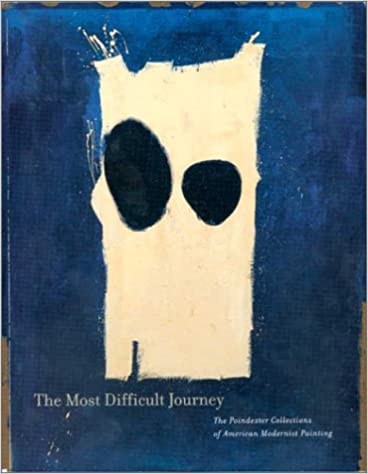
This 112-page, full-color catalog accompanies the exhibition by the same name originated by the Yellowstone Art Museum (in collaboration with the Montana Historical Society). In the catalog’s first essay, Helena poet and independent scholar Rick Newby recounts the “difficult journey,” into the realm of abstract art, undertaken by native Montanan and New York commodity broker George Poindexter. Nothing about Poindexter’s upbringing near Dillon (the Poindexter-Orr Ranch registered the first brand in Montana Territory) or his life as a businessman gave any hint that he would become an important collector of modern art. His wife, Elinor Poindexter, too, became passionate about avant-garde American art, and in 1955, she opened the Poindexter Gallery on New York’s West 56th Street. Together George and Elinor Poindexter assembled an enviable collection of American paintings. Besides excellent examples by such luminaries as de Kooning, Pollock, Kline, Richard Diebenkorn, Philip Guston, and Adolph Gottlieb, the collection included works by many lesser known artists who nonetheless made significant contributions to modern painting in America.
A Ceramic Continuum: Fifty Years of the Archie Bray Influence
(Helena, MT, and Seattle, WA: Holter Museum of Art/University of Washington Press, 2001)
By Rick Newby & Chere Jiusto, Patricia Failing, & Janet Koplos. Edited by Peter Held.
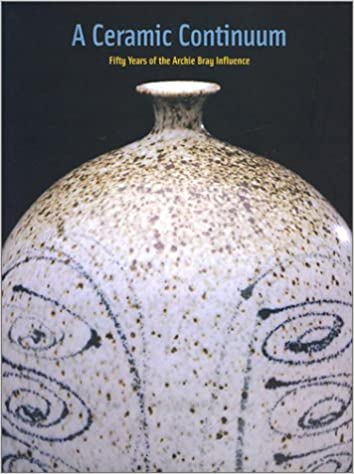
This fiftieth anniversary publication offers a history of the Archie Bray Foundation for the Ceramic Arts, Helena, Montana, and an evaluation of its accomplishments. Through interviews with artists, resident directors, workshop presenters, and the late Peter Meloy, and drawing on the resources of the Foundation’s archives, Rick Newby and Chere Jiusto present its always lively, occasionally conflicted, and unfailingly interesting history through the voices and letters of those who knew it best. Art historian Patricia Failing considers the aesthetic and intellectual influences of the Bray experience upon artists who worked there, and on their later work. Art critic and writer Janet Koplos discusses the unique circumstances that gave rise to the Bray collection and gives a close reading of the 85 objects selected for the exhibition and book.
A Most Desperate Situation: Frontier Adventures of a Young Scout, 1858-1864
(Helena: TwoDot Books, 2000)
By Walter Cooper, illustrated by Charles M. Russell. Edited by Rick Newby.
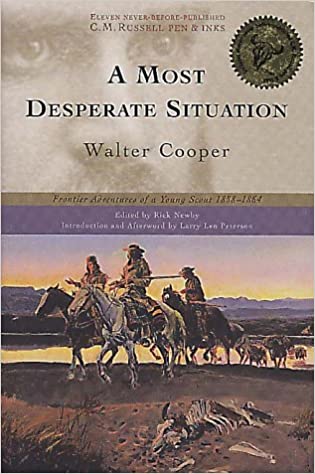
“It is my hope that readers will find here a Western that can hold its own beside other masterpieces of the genre, books like Tough Trip Through Paradise, The Virginian, and The Big Sky. Somewhere between a memoir and a fiction, a potboiler and a folktale, A Most Desperate Situation offers adrenaline-pumping action, a richly imagined western landscape, complexly drawn characters both sympathetic and repellent, spell-binding speeches, scarifying tortures and breathtaking bravery, a tender love story, and the compulsive pleasures of an undeniable page-turner.”
Rick Newby, Editor’s Note
Richard Swanson: Material Witness, Sculpture 1994-1998
(Cheyenne, WY: Fine Arts Gallery, Laramie County Community College, 1999)
by Rick Newby
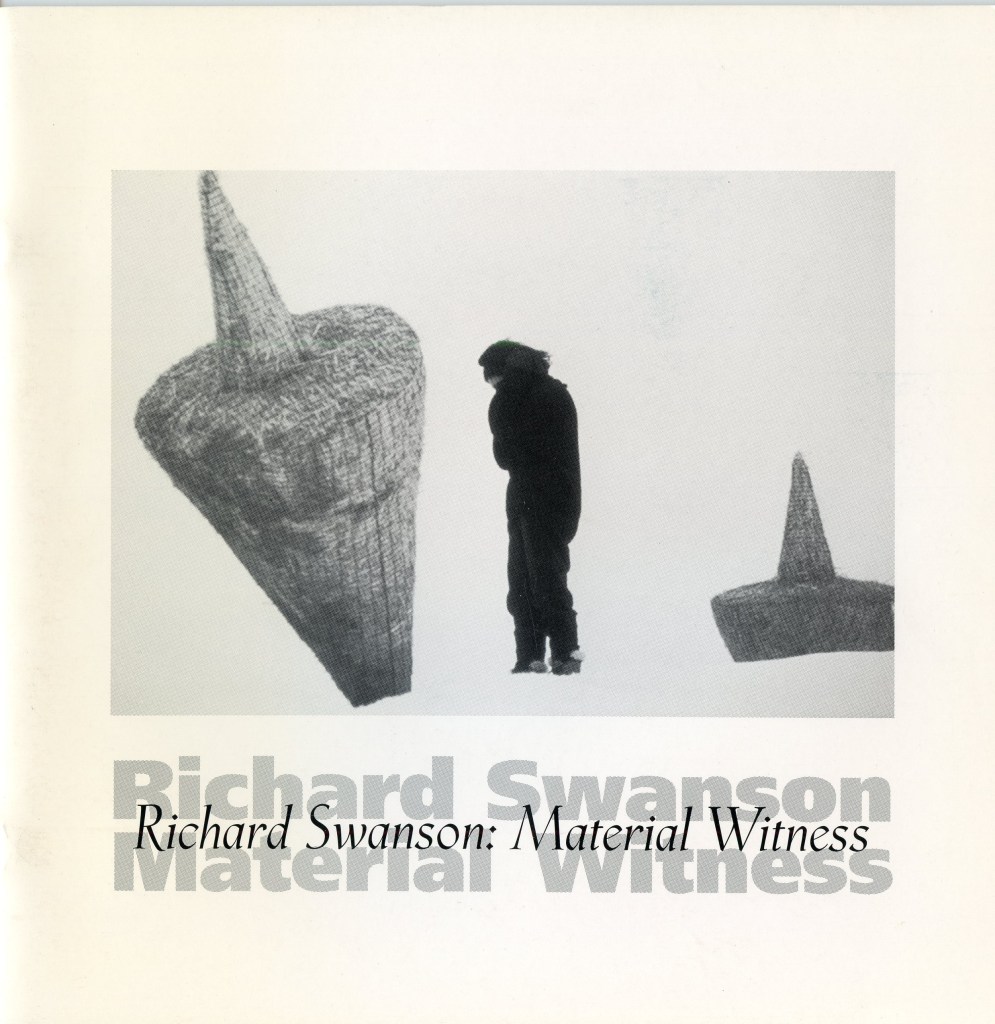
“In an old biscuit factory in Helena, Montana’s warehouse district, Richard Swanson fills his spacious studio with the materials that entice him. Often he has no clear plan for these materials, and it is only out of working with them that forms and rhythms and textures—sculptures—emerge. For the most part, the materials are not those traditional to sculpture, but instead items commonly found, as Swanson says, in “fabric, hardware, and feed stores, ranches, lumber yards, millworks, and ravines”: mattress ticking, window screen, baling twine, straw, peat moss, branches of Rocky Mountain maple, the “porcupine eggs” of cockleburs, barbed wire.
Swanson admits an affinity with the sculptors critic Robert Pincus-Witten has dubbed “post-Minimalist,” artists like Jackie Winsor and Eva Hesse, whose emotionally charged works combine, as do his, “repetitive elements with non-traditional materials and organic forms.” And like the post-Minimalist Martin Puryear, another sculptor he admires greatly, Swanson is imbued with a craft aesthetic and ethic, an almost spiritual need to lavish tremendous effort and care—the mark of the human hand—in the crafting of each of his sculptures.“
from the essay, “Richard Swanson: Organic Memory, Cockleburs, & Barbed Wire,” by Rick Newby
An Ornery Bunch: Tales and Anecdotes Collected by the W.P.A. Montana Writers’ Project
(Helena: TwoDot Books, 1999)
Megan Hiller, Elaine Peterson, Alexandra Swaney, & Rick Newby, editors
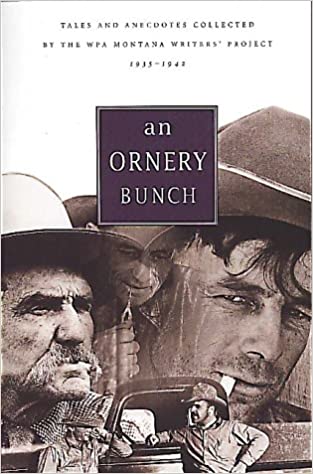
Some of Montana’s first pioneers recorded these outrageous and often hilarious tales covering everything from a poker-playing magpie to the accepted cure for a greedy hunter. Between 1935 and 1942, the field workers for the Montana Writer’s Project of the Works Progress Administration (WPA), conducted oral history interviews and researched folklore for a Montana folklore publication. The United States entered into World War II, and the WPA dissolved before Montana’s efforts on folklore could be published. Now, finally putting the best of the Montana WPA folklore collection in print, An Ornery Bunch presents tales and anecdotes compiled from the immense archives of the Montana’s Writers’ Project.
Walking San Francisco
(Helena, MT: Falcon Publishing, Inc., 1999)
Liz Gans & Rick Newby
(updated 2014 by Tracy Salcedo-Chourre)
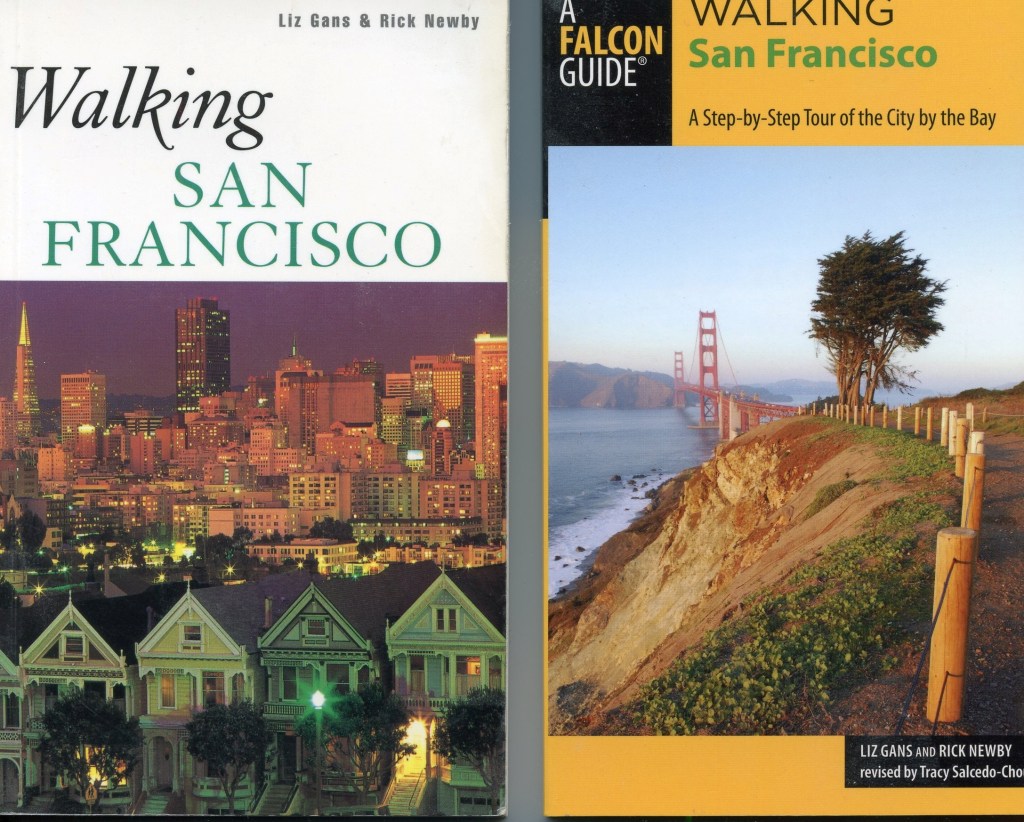
With its stunning natural setting, San Francisco is one of the most congenial American cities for those who love to walk. This vividly written guide features 18 great strolls, including 9 in the Golden Gate National Recreation Area, the world’s largest urban national park. From Fisherman’s Wharf to Chinatown, Golden Gate Park to the Cliff House, the Presidio to the Marin Headlands, cover the City by the Bay on foot, with Walking San Francisco in hand.
Excellent book – the best of its kind on the market. I love this book. I have done about 7 of the walks so far and they have all been brilliant. . . . I frequently leave my apartment with no other guidebook but this one. I really, really recommend it to anyone who wants to get off the beaten track – it is so much more fun to see a city that way.
Leigh Munroe, walker
Writing Montana: Literature under the Big Sky
(Helena: Montana Center for the Book, 1996)
Rick Newby & Suzanne Hunger, editors
Montana is reputed to have one of the most vital literary traditions in the United States. This wide-ranging collection of twenty-seven essays—by leading Montana fiction writers, poets, literature scholars, and historians—analyzes, argues with, and celebrates that unruly tradition.
Old Friends Walking in the Mountains
(Helena: Bedrock Editions, 1994)
By Rick Newby. With twelve etchings by Doug Turman.
“Rick Newby is terrific—with a shrewd eye, a truly original vision, and a delicious capacity to ‘yoke’ very disparate images.”
Nick Lyons
“Rick Newby, navigating by an improbable system of coordinates, has successfully managed to steer clear of the predictable and readily negotiable slackwaters of pure regionalism and has landed on the farther shore miraculously intact. His trajectory through both the tender and the oracular moments of perception propels him on a collision course with the cities of the imagination. Newby signals the emergence of a cosmopolitan Montana poetics. At last.”
Peter Koch
On Flatwillow Creek: The Story of Montana’s N Bar Ranch
(Los Alamos, NM: Exceptional Books, Ltd., 1991)
By Linda Grosskopf, with Rick Newby
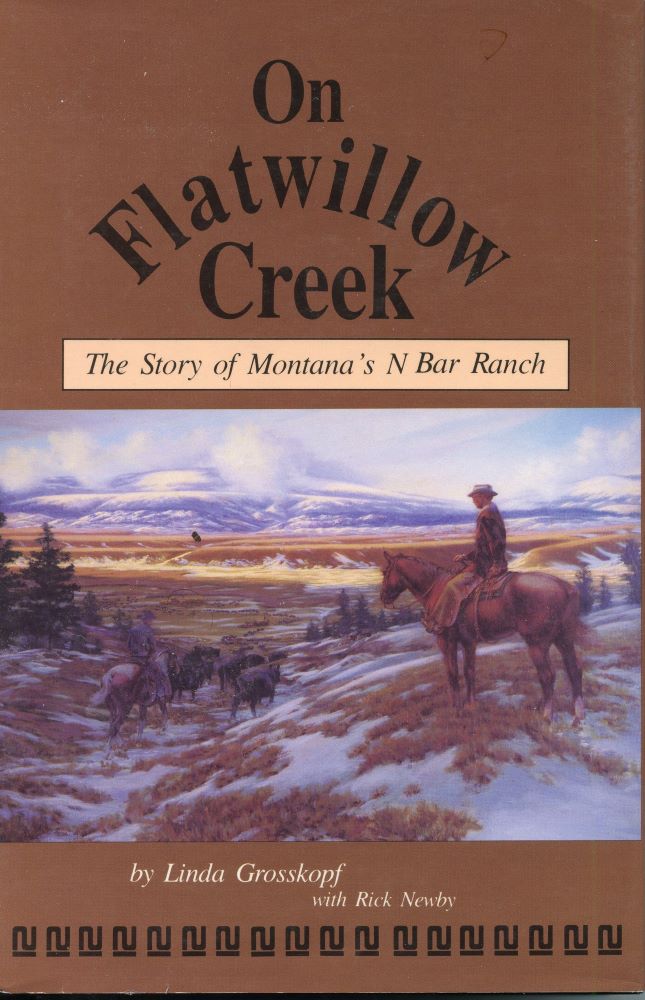
One hundred years of history are stored in the pages of this book. Located near Grass Range, Montana, the N Bar Ranch has been called one of the West’s oldest, biggest, and most colorful spreads. This lively book traces the N Bar’s beginnings in the great Texas cattle drives, its ownership by legendary millionaire Thomas Cruse, its days as a Mormon colony, and its current status as one of the West’s leading Angus producers. Author Linda A. Grosskopf has spent the past five years meticulously compiling this vast, colorful history.
The Man in the Green Loden Overcoat
(Helena: Second Story Verlag, 1983)
By Rick Newby, text, and Jack Jasper, images and design
A collaborative artist’s book
Out of print. Rare.
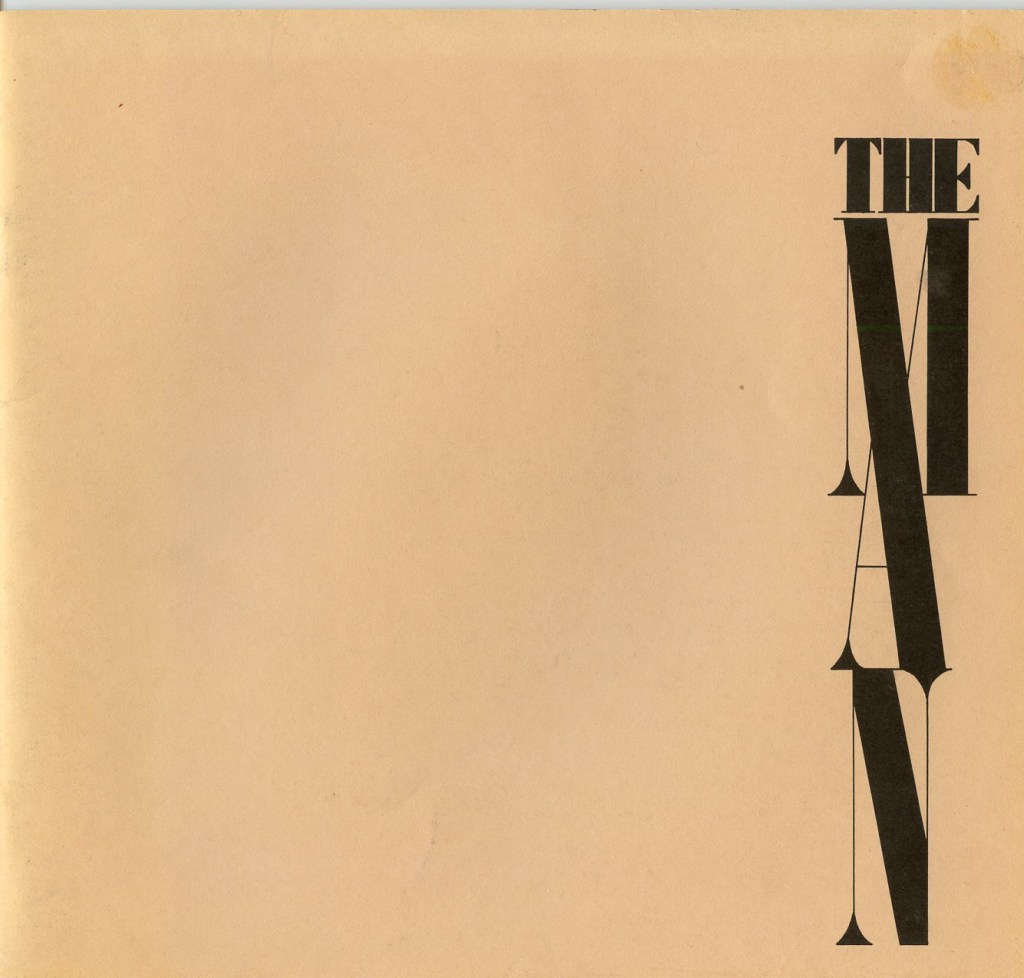
The man in the green loden overcoat is standing there, in the green dappled alley. He stares at the white stucco house, the house where he lived with the woman named Anna, the woman whom he called the Good Anna when he was happy. He was often happy in those days. He had loved her. He still does love.her. But she has left him. Not for another man, but because, as in the old Irish proverb, she has asked for a harder wedding gift than any woman ever asked before: the absence of meanness and jealousy and fear.
Through the open window, he can see: a yellow poster, Le Cameraman, un film de Buster Keaton. The spines of books, brightly colored. A painting of two women, mother and daughter perhaps, the daughter blonde, happy, and barebreasted, the mother wise, her lovely face lined with laughter and an unquenchable desire. He can hear: the melancholy strains of Carla Bley’s Utviklingssang. Piano, bass, and drums, tuba and euphonium, trombone and all the sad saxophones.
Someone has written of “love’s punishment”: “It is always beginning. It never ends.” Someone else has written: “Make no mistake: :the imagination never goes unrequited.”
from The Man in the Green Loden Overcoat, text by Rick Newby
A Radiant Map of the World
(Missoula: Montana Arts Council/ Arrow Graphics, 1981).
By Rick Newby. Wood engravings & drawing by Jim Todd.
Recipient, Montana Arts Council First Book Award, 1981; judges: William Pitt Root and A. B. Guthrie, Jr.
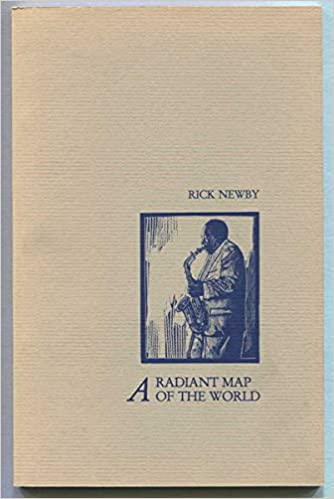
“This compilation of sixteen poems and prose pieces clearly demarcates a world radiant with the poet’s fascinations concerning his art, his books and paintings, the western land he lives in. . . . It would be difficult to ask for a more serious engagement with subject and language befitting each subject than Newby offers us in this book. A Radiant Map of the World is, I think, a book of meticulously thought through, well-sustained poetry; and, admirably, a book of poetry often about Montana which does not exempt non-natives of the state as readers.”
Lyn McCarter, CutBank
“[Rick] Newby writes an enviable prose, and he writes English, not the styro-foam-pellet prose of the large part of fiction nowadays.”
Guy Davenport, author of The Geography of the Imagination
“A Radiant Map of the World is rich evidence of curiosity in the service of an intelligence eager to probe what is unstinting in human nature and equipped to report the findings memorably.”
William Pitt Root
 Rick Newby, Writer & Editor